

A Practical Guide for Property Investors
By Coresworth Research, Coresworth Properties. Examples calculated October 2026.
Key takeaways
- The asking price is only a starting point. The value, the rent and every cost each need their own evidence before you make an offer.
- Yield and return are different numbers. On the same property, the gross yield, the operating yield and the return on your own cash can sit several points apart.
- Set your walk-away price first. Stress-test the numbers, then work backwards to the most you will pay.
A property can look like a bargain, quote a tempting yield and still lose you money.
The asking price is only one number. You also need to know what the property is really worth, what rent a tenant will actually pay, what it costs to buy and run, and what happens when things don’t go to plan. Check those, and you can tell a good deal from one that only looks cheap.
This guide shows how we do it. We take one property that looks brilliant on the listing and run it through seven checks. Then we run a plainer property through the same seven and compare the two. It works whether you’re buying your first rental or your twentieth. If you’re new, the boxes explain every term. If you’ve done it before, the stress tests and the maximum-offer maths are the parts worth slowing down for.
Already know what you want to buy? Send us your criteria now. Otherwise, read on. Both properties are made up, and every assumption is labelled.
In this guide: seven checks and a decision
- Verify the price. Is the discount real?
- Test the rent. What will a tenant really pay?
- Count every cost. From the listing’s yield to the return on your cash.
- Check the rules. What are you allowed to do with it?
- Stress-test the figures. What if two things go wrong?
- Think about the exit. Who buys it from you, or lends against it?
- Recheck the evidence. Is it all still true today?
Then decide: offer, renegotiate or walk away, and work out the most you should pay.
Start with What You Want, not With the Property
Before you open a listing, decide what the investment is for. The same property can be right for one investor and wrong for another, because their money, their time and their appetite for risk differ.
What each strategy is after, and what to look at closely
Swipe sideways to read across.
| Strategy | What you are after | What to look at closely |
|---|---|---|
| Buy-to-let | Rent now and growth over time | Cash flow after costs, tenant demand, repairs and who would buy it later |
| Below market value | A price under a value you can defend | Sold prices, why the seller is discounting, and what it would really sell for |
| Refurbish and refinance (BRRR) | Improve it, let it, then borrow against the higher value | The works budget, the end value, the lender’s rules and the cash left in the deal |
| Shared house (HMO) | More rent from several tenants under one roof | Room demand, planning, licensing, running costs and how much work it takes |
| Value-add | Raise the value by improving or repositioning the property | The discount, the works, the achievable end value and a contingency |
| Capital growth | A long-term rise in value | Local jobs, affordability, new supply and resale demand |
General guidance, not advice for any individual investor. Many deals mix strategies, so decide which one is doing most of the work in yours.
Write your answers down before you start looking. Your budget, locations, strategy, target return, borrowing and the risks you’ll accept become your screening rules. Most listings fail them in seconds, which saves you hours. We come back to this near the end, with a box you can copy.
Now meet the two properties we’ll follow. Property A is the one that makes your pulse race: the listing says it’s 10% below market value and quotes a 9.0% yield. Property B is plain: ready to let, no discount claimed, and a 9.0% yield that matches the evidence. Neither exists. Every figure is an illustration, and every cost is an assumption we label.
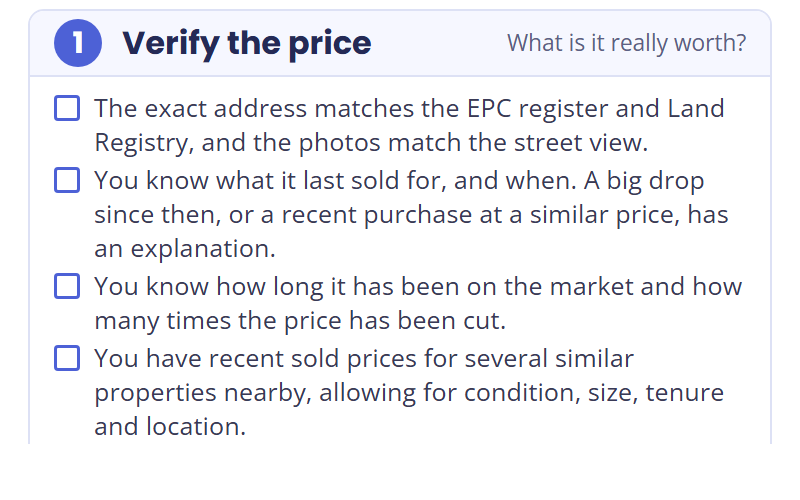
1. Verify the Price
An asking price is the seller’s opening line. It tells you what they hope to get, and nothing about what the property is worth.
The best evidence is what similar homes have actually sold for. HM Land Registry’s Price Paid Data lists sale prices across England and Wales. Here’s how to use it:
- Find recent sales of similar homes on the same street or close by. Match the type, bedrooms, size, condition and tenure.
- Adjust for the differences. A refurbished house isn’t the same as one that needs a new kitchen.
- Work out a range: a cautious value, a middle value and an optimistic one. If they’re far apart, find out why before you choose.
- Ask who would buy it from you later. A flat that suits investors may have few owner-occupier buyers.
Now Property A. The listing asks £180,000 and says the finished property is worth £200,000. Here’s how much of that discount is left.
Property A: is the 10% discount real?
Swipe sideways to read across.
| Item | Amount | Basis |
|---|---|---|
| Asking price | £180,000 | The listing |
| Value when finished | £200,000 | The agent’s estimate, which you would test against sold prices. Assumed for this example |
| Quoted discount | 10% | £20,000 below the £200,000 |
| Works needed | £15,000 | An assumed builder’s quote |
| Contingency | £3,000 | An assumed allowance for surprises |
| Price plus works and contingency | £198,000 | £2,000 under the finished value, a cushion of 1% |
| Stamp duty | £10,100 | Additional property in England, calculated with rates verified July 2026. Check the current rates |
| Legal, survey and mortgage fees | £3,000 | An assumed allowance |
| All-in cost | £211,100 | £11,100 more than the finished value |
Illustrative only. Property A is imaginary, and the finished value, the works, the contingency and the fees are assumptions. Stamp duty depends on the buyer and the property, so confirm it with your solicitor or accountant.
The 10% discount is gone before you’ve counted stamp duty. You’d pay £198,000 for a property worth £200,000, and £211,100 once stamp duty and fees are in. That’s how many “bargains” vanish. The discount is measured against a finished property, and yours isn’t finished yet.
Property A may still work at a lower price. Until you’ve taken off the works and the costs, though, the discount tells you nothing. If you’re borrowing, the lender will value the property too, and their figure can differ from the agent’s, so ask your broker what they’d lend on it.
2. Test the Rent
Rent decides whether the numbers work, and it’s the figure most often rounded up.
- Look at similar properties to rent nearby, and separate what landlords are asking from what tenants actually pay. The ONS private rent figures show rents people really pay, which is stronger evidence than advertised rents, although they’re area averages.
- Ask local letting agents what similar homes let for in practice, and how long they take to let.
- Think about the tenant. Families, professionals and students pay different rents, leave different gaps between tenancies and need different amounts of your time.
- Check demand. Jobs, transport, schools and the number of similar homes to rent all shape it. A city average doesn’t prove one street will let, and our outlooks for Manchester, Leeds, Liverpool, Newcastle and Oxford show how far demand varies from place to place.
For Property A, the listing quotes £1,350 a month. That’s £16,200 a year, or 9.0% on £180,000. Local agents say similar properties let for about £1,200 a month, which is an assumption for this example. At £1,200 the yield is 8.0%. One check, and a full point has gone.
Property B asks £1,050 a month, and that matches the comparable lets. Its yield holds at 9.0%: £12,600 a year on £140,000.
Jargon buster
The six terms this guide uses, in plain English.
- Gross yield
- Annual rent divided by the purchase price.
- Operating yield
- Annual rent less running costs, divided by the purchase price. Some people call it net yield.
- Void
- A period when the property is empty and earns no rent.
- Cash flow
- What is left each year after running costs and mortgage interest, before tax.
- Return on cash invested
- The yearly cash flow divided by the cash you put in, including the deposit and the costs of buying.
- Loan-to-value (LTV)
- The loan as a share of the property’s price or value. At 75% LTV you borrow three quarters and put in the rest.
3. Count every Cost
The price isn’t the only cheque you write. To buy, you’ll pay stamp duty, legal fees, a survey and valuation, mortgage and broker fees, the cost of any works, setup costs such as furniture, any sourcing or agent fees, and a contingency for surprises. To run it, you’ll pay management, repairs, insurance, safety certificates, the cost of empty periods and, for a flat, the service charge and ground rent. Leave one out and the yield looks better than it is.
Here’s Property A, from the listing’s yield down to the return on your own money.
Property A: from the listing’s yield to the return on your cash
Swipe sideways to read across.
| Item | Amount | Basis |
|---|---|---|
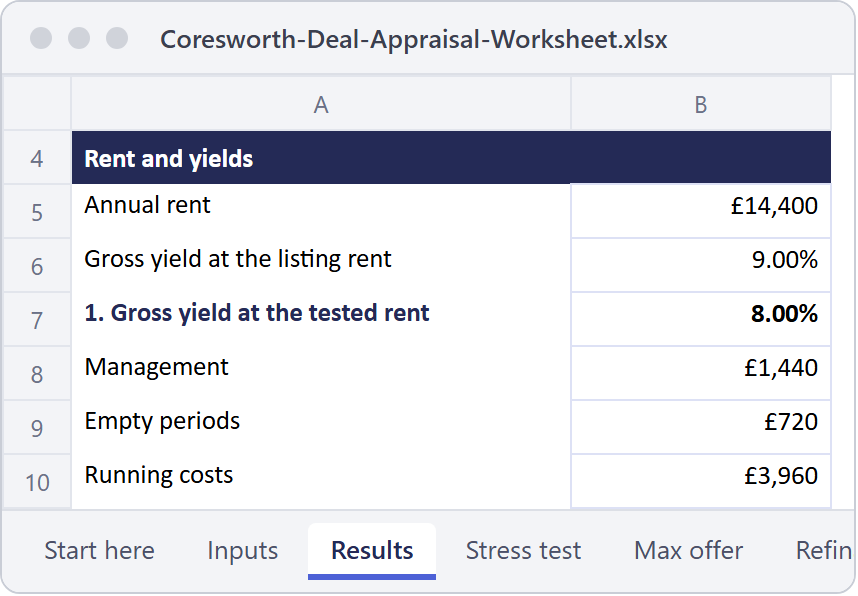
| Annual rent | £14,400 | £1,200 a month for 12 months, the rent comparable lets support |
| 1. Gross yield | 8.00% | £14,400 divided by £180,000. The listing’s £1,350 a month would show 9.00% |
| Running costs | £3,960 | Management 10% of rent (£1,440), maintenance £1,200, empty periods 5% of rent (£720) and insurance and compliance £600, all assumed |
| Operating income | £10,440 | £14,400 less £3,960 |
| 2. Operating yield | 5.80% | £10,440 divided by £180,000 |
| Total cash invested | £76,100 | Deposit £45,000 (25%), stamp duty £10,100, fees £3,000, works £15,000 and contingency £3,000 |
| Mortgage interest | £8,100 | A £135,000 interest-only loan at an assumed 6.0% |
| Cash flow after interest | £2,340 | £10,440 less £8,100, before tax |
| 3. Return on cash invested | 3.07% | £2,340 divided by £76,100, before tax |
Illustrative only. Every cost, the loan and the interest rate are assumptions, so swap in today’s figures. Measured against the all-in cost of £211,100 the operating yield is 4.95%, which is why you should always say which cost you divide by. The example leaves out tax, service charge, ground rent and any fee beyond those listed.
The same property gives three different numbers. Property A’s 8.0% gross yield becomes a 5.80% operating yield and a 3.07% return on the cash you put in. Each one answers a different question, so say which one you’re quoting.
Borrowing deserves a warning. More of it can lift the return on your cash, and it lifts the risk too, so compare deals using the same loan assumptions. These figures are also before tax. How much tax you pay depends on how you own the property and on your circumstances, so confirm it with your accountant. Our guides to Yield vs Void and Yield vs Growth go further into the trade-offs.
4. Check the Rules
What you can legally do with a property matters as much as what it earns. Check these for the exact address:
- Planning. Is the use what you plan? Turning a house into a shared house may need permission, and some areas have extra controls called Article 4 directions.
- Licensing. Councils can require licences for shared houses and, in some areas, for rented homes in general. The national rules for shared houses are on GOV.UK.
- Energy rating. Look up the property’s certificate on the energy certificate register, then find out what the rules say about letting it and what upgrades would cost.
- Tenancy rules. The rules for landlords have changed, and our guide to the Renters’ Rights Act explains the national picture.
- Leasehold. Check the length of the lease, the service charge, the ground rent, any restrictions on letting and any planned major works.
- Title and legal. Ownership, boundaries and covenants are your solicitor’s job to check.
Don’t assume a house that looks like an HMO can legally run as one. Planning and licensing are separate, and having one doesn’t mean you have the other. Rules vary by council and change over time, so check the exact address with the council and take advice where you need it.
You can’t finish every check before your first offer, and that’s normal. Make clear what you’ve assumed, then complete the checks before you’re committed. Your solicitor can tell you how to word your offer. Here’s the list we work through.
Legal and ownership
- Confirm the title, the tenure, the boundaries and any rights over the land.
- Look for covenants, easements and other restrictions.
- For leasehold, read the lease: length, ground rent, service charge and letting restrictions.
- Ask your solicitor to raise the questions you cannot answer yourself.
Physical condition
- Commission a survey that suits the property’s age and type.
- Look into structure, damp, the roof, drainage and the major parts of the building.
- Get specialist reports where the survey recommends them.
- Get itemised quotes for the works rather than a rough total.
Income and costs
- Check the rent against comparable lets.
- Speak to a broker about the mortgage terms.
- Confirm the insurance requirements.
- Get management and maintenance estimates.
- Include compliance, tax and buying costs.
Rules and permissions
- Check the planning status and any permission you will need.
- Check the licensing and safety duties that apply to the address.
- Confirm that your letting plan is lawful and practical for this property.
- Ask the council where the rules are unclear.
Exit and reserves
- Think about who would buy it from you.
- Plan for a slow sale or a refinance that takes longer than expected.
- Keep cash for repairs and empty periods.
- Decide in advance what would make you walk away.
5. Stress-Test the Figures
Your base case assumes everything goes to plan. It won’t. So test the deal before reality does: a higher interest rate, a lower rent, longer empty periods and a repair bill, first one at a time and then together. Interest rates and rents both move, and a deal that only works when everything goes right is fragile.
Here are Property A and Property B under the same tests. Both borrow 75% of the price on interest-only terms at an assumed 6.0%. To let you check our working, Property B costs £140,000 and lets for £1,050 a month. Stamp duty is £7,300 and fees are £3,000. It needs no works, so we allow just £1,500 for contingency, and £46,800 of your own cash goes in. Running costs are £3,390 a year, with maintenance at £900 because it’s ready to let.
Properties A and B under the same stress tests
Swipe sideways to read across.
| Test | Property A | Property B |
|---|---|---|
| Price and rent assumed | £180,000, £1,200 a month | £140,000, £1,050 a month |
| Cash invested | £76,100 | £46,800 |
| Base case cash flow, 6.0% interest | £2,340 | £2,910 |
| Base case return on cash | 3.07% | 6.22% |
| Interest rate at 7.0% | £990 | £1,860 |
| Rent 10% lower | £1,116 | £1,839 |
| Both together | A loss of £234 | £789 in credit |
| Break-even rent at 6.0% | £971 a month | £765 a month |
| Break-even rent at 7.0% | £1,103 a month | £868 a month |
Illustrative only. Both properties borrow 75% of the price on interest-only terms at an assumed 6.0%, or 7.0% in the tests, and every figure is before tax. Management (10%) and empty periods (5%) are charged as a share of rent, so they fall when the rent falls, while maintenance and insurance stay fixed. Property A’s maintenance is £1,200 and Property B’s is £900 because it is ready to let. The break-even rent is the rent that covers running costs and interest and leaves nothing over.
Property A falls over when two things go wrong at once. With interest at 7.0% and the rent 10% lower, it loses £234 a year. Property B stays £789 in credit. The break-even rent shows the same gap. That’s the rent that covers running costs and interest and leaves nothing over. A needs £971 a month at 6.0% interest and B needs £765, so B has far more room before it starts losing money.
Neither deal copes with a big repair on its own. A £3,000 bill would use up more than a year’s cash flow on either property, which is why you keep a reserve and test a repair separately. Lenders also run their own tests on the rent before they’ll lend, so ask a broker what they’d offer on the property you’re looking at.
6. Think About the Exit
Before you buy, know how you’d get out, because plans change. Ask yourself:
- Who would buy it? Investors, owner-occupiers or both, and how many of them are there?
- What could shrink the pool? Condition, tenure, licensing or a weak local market can all put buyers off.
- How long could a sale take? If it took six months longer than planned, could you cope?
- What if you need to refinance? The lender’s valuation and rent test decide how much cash comes back.
Refinancing deserves its own example, because it’s where refurbishment plans can come up short. A BRRR deal (buy, refurbish, rent, refinance) aims to pull your cash back out by borrowing against the higher value. Say you buy for £150,000, spend £25,000 on works and pay £11,000 in stamp duty and fees. You expect it to be worth £220,000 afterwards.
A refurbish and refinance deal, with two valuations
Swipe sideways to read across.
| Item | If the valuation is £220,000 | If it is £205,000 |
|---|---|---|
| Purchase price | £150,000 | £150,000 |
| Works | £25,000 | £25,000 |
| Stamp duty and fees | £11,000 | £11,000 |
| Total project cost | £186,000 | £186,000 |
| Refinance at 75% of the valuation | £165,000 | £153,750 |
| Cash left in the deal | £21,000 | £32,250 |
Illustrative only. The valuations, the works and the 75% loan limit are assumptions, and a lender may value, lend and test the rent differently. Stamp duty of £8,000 is calculated for an additional property in England with rates verified July 2026, and the £3,000 of fees is assumed. The example ignores finance costs and the time the work takes.
Even a successful refurbishment doesn’t always return all your cash. At the valuation you hoped for, £21,000 stays in the deal. If the lender values it at £205,000, £32,250 does. The 75% is an assumption and not a promise of what a lender will offer, and they’ll check that the rent covers the new loan too. Test the valuation as hard as you test the rent.
7. Recheck the Evidence
Between your first look and the day you commit, things shift. A rate changes, a comparable sells for less, the survey finds damp or a council updates a rule. Recheck the price, the rent, the borrowing costs and the rules on the day you offer, and again before you’re committed. The figures in this guide are a snapshot, and so is every listing.
Where to check the evidence (8 sources)
- HM Land Registry Price Paid Data: what similar properties sold for.
- HM Land Registry UK House Price Index: how prices are moving by area.
- ONS, Private rent and house prices: the rents tenants pay, by area.
- GOV.UK, Find an energy certificate: a property’s energy rating.
- GOV.UK, House in multiple occupation licence: the national licensing rules for shared houses.
- GOV.UK, Find your local council: planning, Article 4 and licensing pages for the address.
- GOV.UK, Stamp Duty Land Tax residential rates: the current bands, and the extra charge on additional properties.
- Bank of England, Bank Rate: where the base rate stands, which feeds into mortgage rates.
Putting the Seven checks Together
Here are Property A and Property B across all seven. We use three marks: Pass when the evidence supports it, Review when a question is still open, and Fail when the deal doesn’t work as it stands.
Property A and Property B through the seven checks
Swipe sideways to read across.
| Check | Property A | Property B |
|---|---|---|
| 1. Verify the price | Review. The 10% discount disappears once the works and costs are counted | Pass. The asking price matches comparable sales, assumed |
| 2. Test the rent | Review. The listing says £1,350 a month and comparable lets say £1,200 | Pass. £1,050 a month matches comparable lets, assumed |
| 3. Count every cost | Review. £76,100 invested for a 3.07% return on cash, and a 5.80% operating yield | Pass. £46,800 invested for a 6.22% return on cash, and a 6.58% operating yield |
| 4. Check the rules | Review. Confirm what the works involve and the property’s energy rating before you commit | Pass, subject to confirming it is ready to let with its certificates in place, assumed |
| 5. Stress-test the figures | Fail. A loss of £234 a year when the rate and the rent both move | Pass. Still £789 in credit under the same test |
| 6. Think about the exit | Review. The value depends on the works finishing to the standard the agent assumes | Pass. A wide pool of buyers, assumed |
| 7. Recheck the evidence | Open. Recheck on the day you offer | Open. Recheck on the day you offer |
| Overall | Renegotiate hard, or walk away at £180,000 | Worth pursuing, subject to the checks |
Illustrative only. Pass means the evidence supports it, Review means a question is still open, and Fail means the deal does not work as it stands. Both properties are imaginary, and Property B is deliberately plain. A real one would have risks of its own.
One Fail can be enough to stop a deal, however well the rest scores. Record what you’ve verified, what you’ve estimated and what’s still unknown, and put a date on every open check. The same process works for a first-time buyer and for someone with twenty properties. It takes the feeling out of the decision and lets you compare deals fairly.
Property B is deliberately plain. The point is to show the same checks giving different answers, so don’t read it as saying cheaper properties are better. A real one would have risks of its own.
Go deeper on each check
One short guide for each of the seven checks, published weekly.
- Verify the price: Is the Discount Real?
- Test the rent: coming soon
- Count every cost: coming soon
- Check the rules: coming soon
- Stress-test the figures: coming soon
- Think about the exit: coming soon
- Recheck the evidence: coming soon
Decide: Offer, Renegotiate or Walk Away
Once the checks are done, there are three outcomes.
Make an offer when the evidence supports the price, the returns meet your criteria, the funding is realistic and you understand the main risks.
Renegotiate when the property has potential but the price doesn’t pay you for the work, the cost or the risk. Take your evidence with you: sold prices, quotes for the works, survey findings and your own numbers. Any seller will take a reasoned offer more seriously than a low number with nothing behind it.
Walk away when the deal needs an unsupported valuation, an optimistic rent, missing costs, finance you can’t get or a rule problem you can’t solve.
Your maximum offer comes from your numbers, and the asking price doesn’t come into it. Work backwards from what you need. For Property A, say we set two example rules.
Property A: two example rules for a maximum price
Swipe sideways to read across.
| Rule | Maximum price | How it is worked out |
|---|---|---|
| 1. Price plus works and contingency stays at least 10% under the finished value | £162,000 | £200,000 less 10% is £180,000, and £180,000 less £18,000 of works and contingency is £162,000 |
| 2. Cash flow stays at zero or better at 7.0% interest and a 10% lower rent | About £175,500 | At 75% borrowing, the interest must not exceed the £9,216 of operating income left when the rent falls to £1,080 a month |
| Your maximum offer | £162,000 | The lower of the two, which is 10% under the £180,000 asking price |
| Property A at £162,000 | 4.48% return on cash | Stamp duty £8,840, cash invested £70,340, operating yield 6.44%, cash flow £3,150 at 6.0% and £711 at 7.0% with a 10% lower rent |
Illustrative only. The two rules are examples of the method and not a recommendation, so set your own. Stamp duty is calculated for an additional property in England with rates verified July 2026.
The lower of the two sets your maximum: £162,000, which is 10% under the asking price. At that price Property A returns 4.48% on your cash and stays in credit under the two-things-wrong test. Whether 4.48% is enough is your decision. If your minimum is higher, your maximum price drops again, or Property A isn’t your deal.
Those two rules are examples. Set your own before you start negotiating, because it’s easy to loosen them to win a property you’ve fallen for. If the seller won’t meet your number, walk away. Another property will come along.
Two free tools, two jobs
Use them in order. The checklist tells you what to look for, and the worksheet turns what you find into numbers.
7 Step Test Investor Checklist
- Use it
- At the viewing, and before you make an offer.
- It answers
- What should I check?
- You get
- A two-page printable PDF with tick boxes and questions to ask the agent.
Deal Appraisal Worksheet
- Use it
- Once you have the price, the rent and your costs.
- It answers
- What do the numbers say, and what is the most I should pay?
- You get
- An Excel worksheet, filled in with an example, and a four-page how-to guide.
Both are free, and each asks for your name and email so we can send it to you.
Mistakes even Experienced Investors Make
Everyone makes some of these at some point. The trick is to spot them before the money is committed.
Eight mistakes to avoid
Frequently asked Questions
How do I know if a property is a good investment?
Check that its value is backed by sold prices and its rent by comparable lets, and that every cost is counted. Then stress-test the result, check the rules and think about your exit. A good investment still works when your assumptions turn out a little worse than planned.
What is the difference between gross yield and net yield?
Gross yield divides a year’s rent by the price. Net yield, which this guide calls operating yield, takes the running costs off the rent first, so it shows what the property earns before mortgage interest and tax. Always say which figure you are quoting and which price you divided by.
What is a good rental yield?
There is no single answer. It depends on your strategy, the area, your borrowing and what you need from the property. A high yield can point to weak demand, heavy costs or tight rules, so ask why it is high, then work out the return on your own cash after costs.
How much below the asking price should I offer?
Let your numbers decide, and skip any standard percentage. Work out the most you can pay, then back your offer with evidence such as sold prices, quotes for the works and survey findings.
What should I stress-test before I make an offer?
Test a higher interest rate, a lower rent, longer empty periods and a repair bill, one at a time and then together. If you plan to refinance, test a lower valuation as well, and keep a cash reserve for what you cannot predict.
What does a Good Deal Look Like?
A good deal survives checking. Its value is backed by sold prices and its rent by comparable lets. Every cost is counted, the rules allow what you plan, and the numbers still work when things go wrong. Property A looked better on the listing. Property B looked plainer and held up.
Before you make an offer, ask yourself five questions:
- Is the property’s value backed by evidence?
- Have I counted every cost of buying and owning it?
- Does it meet my return target on realistic assumptions?
- Could I cope if the next twelve months turn out worse than expected?
- Do I have a way out if the plan changes?
If you can’t answer yes to all five, the next step is more checking rather than a higher offer.
Work With Coresworth
Checking a deal properly takes time, and that’s where we come in. We source properties against your written criteria and run each one through these seven checks, and you decide whether to go ahead.
Your investor brief
A brief separates the properties that merely look good from the ones that fit. Write these six things down, then send them to us.
- Your purchase budget and any money for works.
- The locations you are willing to consider.
- Your property type and letting strategy.
- Your target gross yield, operating yield or cash return.
- Your finance assumptions and the risks you will accept.
- Your minimum property standards, and the strategies you do not want.
Written it down? We’ll source against it.
Send Coresworth your briefNot sure where to look? Our outlooks for Manchester, Leeds, Liverpool, Newcastle and Oxford are already published.
This article is general information and is not investment advice. Property values, rents, borrowing costs, tax rules and landlord obligations can change. The worked examples are imaginary, are not forecasts, and are not assured returns. Investors should carry out their own due diligence and obtain appropriate legal, tax, mortgage, planning and licensing advice before committing to a purchase.
Coresworth Research writes the Propertyology series for Coresworth Properties. Figures are drawn from published sources, which are linked at the end of each article.
Sources
Each source is labelled by the kind of evidence it gives.
- Official data. HM Land Registry: Price Paid Data (what properties sold for) and UK House Price Index reports (price movements by area).
- Official statistics. Office for National Statistics: Private rent and house prices, UK (rents paid by area).
- Official guidance. GOV.UK: Stamp Duty Land Tax residential rates, Stamp Duty Land Tax: buying an additional residential property, House in multiple occupation licence, Find an energy certificate and Find your local council.
- Official rate. Bank of England: Bank Rate.
- Illustrative. Property A, Property B and the refinance example are imaginary. The calculations are by Coresworth Research from the stated assumptions, with stamp duty from a calculator using rates verified in July 2026.
Examples calculated 25 October 2026. Stamp duty rules, interest rates, rents and licensing rules can change. Investors should carry out their own due diligence before making investment decisions.