
By Coresworth Research, Coresworth Properties. Examples calculated October 2026.
Key takeaways
- "Below market value" is a claim to test. It rests on someone's estimate of the finished value, so check it against sold prices.
- A discount only counts after the works and the costs. Take off the works, a contingency, stamp duty and fees before you decide what is left.
- Work backwards from the discount you want. Decide the real cushion you need, then find the price that delivers it.
This is check 1 of 7. Read the full guide, How to Analyse a Property Deal Before Making an Offer, for all seven checks and the two example properties.
"10% below market value" is one of the most tempting lines in a property listing. It's also a claim, and it needs checking before it changes what you offer.
Two guesses sit behind it: what the property will be worth when it's finished, and what it takes to get it there. Both come from someone who wants the sale. This guide shows how to test each one, count what is left of the discount and find the price that leaves a real one.
It's the first check in our seven-check method, set out in full in How to Analyse a Property Deal Before Making an Offer, and it uses Property A from that guide. Property A is imaginary. The listing asks £180,000, says the property is worth £200,000 when finished and calls that a 10% discount. Every cost is an assumption we label.
Who Is Telling You the Value?
Nobody knows a property's market value until it sells. Until then you have estimates, and each one comes from someone with a different interest.
Four views of what a property is worth
The discount in a listing is measured against the first of those, and usually against the property in its finished state. That's the figure to push on.
Start with What Similar Homes Sold For
Sold prices are the best evidence you can get for free. HM Land Registry's Price Paid Data lists what homes in England and Wales actually sold for, so you can compare like with like:
- Find recent sales of similar homes nearby. Match the type, bedrooms, size, condition and tenure.
- Check the condition. A sale of a refurbished home only supports a finished value if your refurbishment would reach the same standard.
- Allow for the date. Prices move, so see how the area has changed since each sale in the UK House Price Index reports.
- Build a range: a cautious value, a middle value and an optimistic one. If they're far apart, find out why before you choose one.
Ask how long the property has been listed and whether its price has changed. A price cut shows what buyers made of the first number. A sale can take a while to appear in the Land Registry data, so the very latest ones may be missing, and local agents can tell you about those.
Take Off What It Takes to Get There
A property that needs work isn't worth its finished value today. You'll spend money to get it there, and the discount has to cover that spend, plus the cost of buying, before it counts as a saving.
Here's Property A. The listing asks £180,000 and says the finished property is worth £200,000. We assume a builder's quote of £15,000 for the works and £3,000 for the surprises you can't see yet.
Property A: what is left of the 10% discount
Each bar is what you have spent so far, as a share of the £200,000 finished value. The gold line marks 100%. Once a bar goes past it, you have spent more than the property will be worth.
Illustrative only. Property A is imaginary. The finished value, the works, the contingency and the fees are assumptions. Stamp duty is for an additional property in England, calculated with rates verified July 2026, so check the current rates.
The 10% discount is gone before stamp duty and fees go in. After the works and the contingency you've paid £198,000 for a property worth £200,000, a cushion of 1%. With stamp duty and fees you've spent £211,100, which is £11,100 more than the property is worth when it's finished.
None of this makes Property A a bad property. At the asking price the discount has gone, and at a lower price some of it comes back. We find that price below.
Ask Why It's Cheap
A property sells under its finished value for a reason. Find the reason before you count the saving, because some reasons can be fixed with money and others stay with the property.
Six reasons a property is priced under market
Swipe sideways to read across.
| The reason | What it can mean | What to check |
|---|---|---|
| It needs work | The price already reflects some of the cost, and the works can run over | Itemised quotes, a survey and a contingency for what you cannot see |
| A short lease | Fewer lenders will lend on it, and fewer buyers want it later | The years left, the ground rent, the service charge, what an extension would cost and what a broker says |
| A seller in a hurry | Probate, a move or a broken chain can make speed worth more than price | The timetable, whether you can meet it, and your funding |
| An auction or quick sale | Short deadlines, and you buy what the legal pack says you buy | The legal pack read with your solicitor, finance ready to go, and a survey before you bid where you can |
| A problem with the building or the area | Damp, movement, flood risk or a council rule that limits what you can do | A survey, the flood and planning checks, and the council for the exact address |
| An optimistic listing | The "market value" is the agent's hope for the finished property | Sold prices for similar homes in the same condition |
General guidance, not advice for any individual investor. The rules on leases, licensing and planning vary by property and by council, so check the exact address.
Some of these are fair trades. A seller who needs a quick, certain sale may take less for it, and you can pay a fair price for speed. Build your plan on the evidence and treat the seller properly, because a deal that depends on someone's difficulty is more likely to fall through.
Check the Number the Lender Will Use
If you're borrowing, the lender's surveyor will value the property for the loan, and their figure can differ from the agent's. If it comes in below the price you agreed, the shortfall is cash you'll have to find. Ask your mortgage broker what a lender is likely to value and lend on it before you offer. Our guide covers the same point under Think About the Exit.
Find the Price That Leaves a Real Discount
Work backwards. Decide the discount you want after every cost, then find the price that delivers it. For Property A, say your rule is that all the costs together must come to at least 10% under the finished value. That's £180,000 on a £200,000 property.
Property A: four prices and what each leaves
Swipe sideways to read across.
| Price you pay | Stamp duty | All-in cost | Against £200,000 finished | Below the £180,000 asking price |
|---|---|---|---|---|
| £180,000, the asking price | £10,100 | £211,100 | £11,100 over (5.55%) | None |
| £169,600 | £9,372 | £199,972 | Level with the finished value, so no real discount | 5.8% |
| £162,000, the example maximum in our guide | £8,840 | £191,840 | £8,160 under (4.08%) | 10.0% |
| £150,900 | £8,063 | £179,963 | £20,037 under (10.02%) | 16.2% |
Illustrative only. The all-in cost is the price, stamp duty, £3,000 of fees, £15,000 of works and a £3,000 contingency, all assumed apart from the stamp duty, which is for an additional property in England at rates verified July 2026. Prices are rounded to the nearest £100. Check the current rates before you rely on any figure.
To keep a real 10%, you'd pay about £150,900. That's roughly 16% under the asking price, and well below the 10% the listing advertised. Whether this seller would accept it is a separate question. Take your sold prices and your quotes into the conversation, and if the seller won't come near your number, walk away.
In our full guide, Property A's example maximum offer is £162,000, which leaves a real discount of 4.08%. Those are example rules. Set your own before you start negotiating, because it's easy to loosen them when you've fallen for a property.
Two free tools, two jobs
Use them in order. The checklist tells you what to look for, and the worksheet turns what you find into numbers.
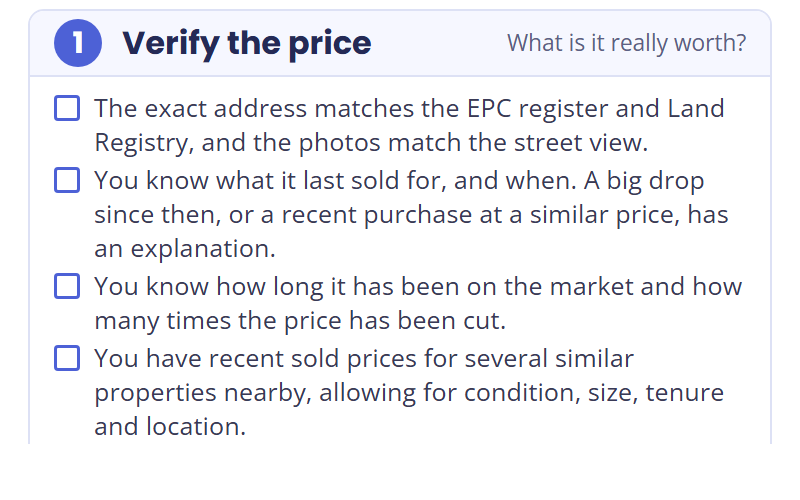
7 Step Test Investor Checklist
- Use it
- At the viewing, and before you make an offer.
- It answers
- What should I check?
- You get
- A two-page printable PDF with tick boxes and questions to ask the agent.
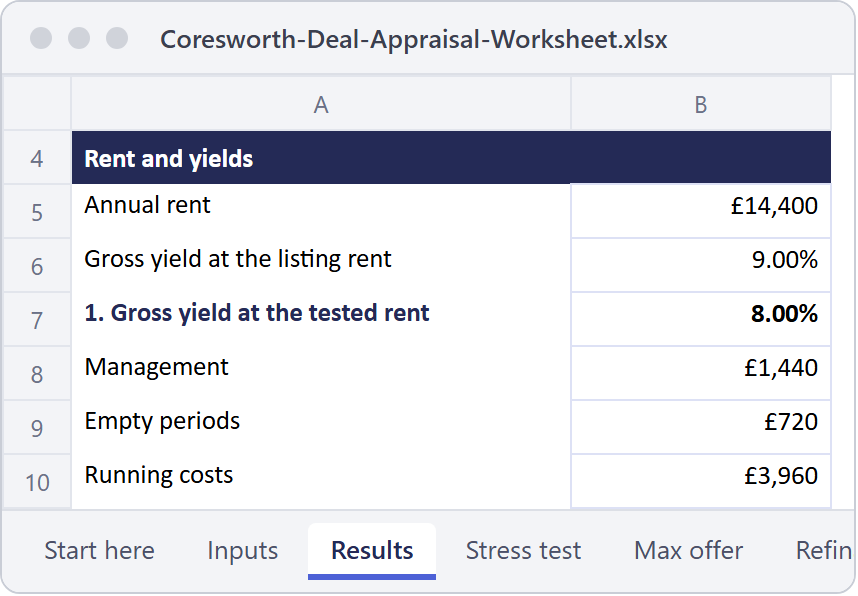
Deal Appraisal Worksheet
- Use it
- Once you have the price, the rent and your costs.
- It answers
- What do the numbers say, and what is the most I should pay?
- You get
- An Excel worksheet, filled in with an example, and a four-page how-to guide.
Both are free, and each asks for your name and email so we can send it to you.
Five Questions for Any Below-Market-Value Listing
Ask these before you offer
Five questions for any "below market value" listing.
- What is the finished value, and which sold prices back it?
- What does the property need to reach that state, and who quoted it?
- After the works, a contingency, stamp duty and fees, what is left of the discount?
- Why is the seller pricing it under the finished value?
- What will my lender value it at?
Frequently asked Questions
What does below market value mean?
It means the asking price is lower than the value someone puts on the property. That value is an opinion until a sale proves it, so ask who gave it, what condition it assumes and which sold prices support it.
How much below market value should a property be?
There is no single figure. It depends on the works, the risks, your costs and the return you need. Count the discount after every cost, and set your minimum before you start looking.
Can I trust the agent's valuation?
Treat it as a starting point. The agent acts for the seller, so check it against sold prices for similar homes, and find out what your lender would value it at before you offer.
How do I check what a property is worth?
Compare it with recent sales of similar homes nearby, adjust for condition and date, and build a cautious, a middle and an optimistic value. A surveyor can give you an independent opinion, and your broker can tell you what a lender is likely to accept.
What does a Real Discount Look Like?
A real discount is the one left after the works, the contingency, stamp duty and fees. It rests on sold prices for the value and on quotes for the works, and you can explain why the seller is taking less. The number on the listing is where your checking starts.
Work With Coresworth
Checking a deal properly takes time, and that's where we come in. We source properties against your written criteria and run each one through the seven checks, and you decide whether to go ahead.
Send Coresworth your investment criteriaNot sure where to look? Our outlooks for Manchester, Leeds, Liverpool, Newcastle and Oxford are already published.
This article is general information and is not investment advice. Property values, building costs, borrowing costs, tax rules and landlord obligations can change. The worked example is imaginary, is not a forecast, and is not an assured return. Investors should carry out their own due diligence and obtain appropriate legal, tax, mortgage, planning and licensing advice before committing to a purchase.
Coresworth Research writes the Propertyology series for Coresworth Properties. Figures are drawn from published sources, which are linked at the end of each article.
Sources
Each source is labelled by the kind of evidence it gives.
- Official data. HM Land Registry: Price Paid Data (what properties sold for) and UK House Price Index reports (price movements by area).
- Official guidance. GOV.UK: Stamp Duty Land Tax residential rates and Stamp Duty Land Tax: buying an additional residential property.
- Illustrative. Property A, its value, its works and its costs are imaginary. The calculations are by Coresworth Research from the stated assumptions, with stamp duty from a calculator using rates verified in July 2026.
Examples calculated 27 October 2026. Stamp duty rules, building costs and lender criteria can change. Investors should carry out their own due diligence before making investment decisions.