

By Coresworth Research, Coresworth Properties. Examples calculated October 2026.
Key takeaways
- A deal that only survives when everything goes right is fragile. Test a higher rate, a lower rent, a longer void and a repair bill, one at a time and then together.
- Your lender runs its own test before you borrow a penny. The interest coverage ratio, not your own cash flow, decides how much you can actually borrow.
- Size your reserve to the percentage, not just the pounds. A smaller deal’s worst case can still be the bigger share of the cash you put in.
This is check 5 of 7. Read the full guide, How to Analyse a Property Deal Before Making an Offer, for all seven checks and the two example properties.
A deal that only works when everything goes right is fragile, and everything rarely goes right for an entire tenancy, let alone for twenty-five years of a mortgage.
Rates rise, a tenant leaves, a boiler fails. What matters is what the deal does when one of them happens, not whether it happens at all. Stress-testing is simply running your numbers through a worse year than the one you’re hoping for, before you’ve committed any money, so a bad surprise costs you nothing more than a few minutes at a spreadsheet.
Get this right and you avoid two different kinds of regret: paying for a deal that only ever worked on paper, and losing one you’d underwritten properly to a lender’s own test you never saw coming. Fifteen minutes with the numbers below tells you which one you’re looking at.
It’s the fifth check in our seven-check method, set out in full in How to Analyse a Property Deal Before Making an Offer, and it uses Property A and Property B from that guide. Both are imaginary. Property A asks £180,000 and rents for £1,200 a month on local agents’ evidence. Property B asks £140,000 and rents for £1,050 a month, matching its evidence exactly. Every figure here, including the stress rates and the void and repair figures, is an assumption we label.
What Actually Goes Wrong
These are the same four things step 5 of our 7-Step Test checklist asks you to check, worked through here in full rather than as a tick box. Each one moves independently of the others, and each on its own can turn a comfortable deal into a tight one.
- Interest. Can the property withstand a higher mortgage rate?
- Rental income. What happens if the rent you actually collect is lower than you hoped?
- Voids. Can you afford the property sitting empty longer than you’ve already planned for?
- Repairs. Can an unexpected repair bill be covered without extra borrowing?
Test them one at a time first, so you know which one your deal is most exposed to, then stack them together, because a bad year rarely brings only one problem.
Property A and Property B, one stress added at a time
Swipe sideways to read across.
| Stress added | Property A | Property B |
|---|---|---|
| Base case: 6.0% interest, full rent | £2,340 | £2,910 |
| + Interest rate rises to 7.0% | £990 | £1,860 |
| + Rent 10% lower | A loss of £234 | £789 |
| + An extra void, two months longer than already allowed for | A loss of £2,394 | A loss of £1,101 |
| + A single £3,000 repair, all four together | A loss of £5,394 | A loss of £4,101 |
Illustrative only. Each row adds one further stress on top of all the ones above it. Both properties borrow 75% of the price on interest-only terms. Running costs already include a 5% void allowance, so the extra void tested here is on top of that, representing an unplanned gap such as a difficult re-let. The repair bill is a flat £3,000 assumption on either property. Every figure is before tax.
Property A is already losing money by the third stress, and Property B by the fourth. A loses £234 a year once the rate rises to 7.0% and the rent falls 10% together. B still holds £789 in credit at that point, and only tips into a loss once an unplanned extra void is added on top. Add a single £3,000 repair bill to either, and both end the year well into the red: a loss of £5,394 for A and £4,101 for B. Neither number is a prediction. They’re what happens if a run of ordinary bad luck lands in the same twelve months.
As a share of the cash each investor put in, Property B’s worst case is actually the bigger hit. B’s £4,101 loss is 8.8% of the £46,800 invested in it, against A’s £5,394 being 7.1% of its £76,100. A smaller deal needs a smaller cash reserve in pounds, but that reserve can still represent just as much, or more, of what’s actually at stake. Size the reserve to the percentage, not just the number.
One assumption behind every figure above: both properties are borrowed on interest-only terms, which isolates the effect of a rate change on interest alone. If you’re on a repayment mortgage, your monthly payment is higher from day one because it already includes paying down the loan, and a rate rise pushes it higher still. Run the same stress test on your actual repayment figure rather than the interest-only one here, and remember that part of what you’re paying is reducing what you owe, not money gone.
Keeping a reserve big enough to absorb a bad year, rather than forcing a sale or more borrowing at the worst possible moment, is standard practice among experienced landlords. Many keep three to six months of running costs and mortgage interest set aside per property. Decide your own figure before you buy, not after the boiler goes.
The Test You Don’t Run, Your Lender Does
If you’re borrowing, there’s a stress test that happens whether you run one or not, and it decides how much you can borrow in the first place, not just how comfortable the deal feels afterwards.
What your lender actually checks
The interest coverage ratio, in plain English.
- Interest coverage ratio (ICR)
- The annual rent as a percentage of the annual interest at the lender’s stressed rate, not your own pay rate.
- Stressed rate
- Usually your own rate plus at least 2 percentage points, with a floor of 5.5% if that calculation comes out lower.
- Usual minimum ICR, basic-rate taxpayer
- 125% of the stressed interest payment. A market practice figure, not a fixed number set by the regulator.
- Usual minimum ICR, higher-rate taxpayer
- 145%, reflecting the extra tax a higher-rate landlord pays under Section 24.
- Five-year fix exception
- A mortgage fixed for five years or more is usually exempt from the 2-point add-on, so it is often tested closer to the rate you are actually paying.
The regulator requires lenders to test the rent against the mortgage payment at a notional, stressed interest rate rather than the rate you’re actually paying, using a measure called the interest coverage ratio, or ICR: the annual rent as a percentage of the annual interest at that stressed rate. The stressed rate is usually your own rate plus at least two percentage points, with a floor of 5.5% if that calculation comes out lower. The minimum ICR most lenders require is 125% for a basic-rate taxpayer and 145% for a higher-rate taxpayer, reflecting the extra tax a higher-rate landlord pays under Section 24. A mortgage fixed for five years or more is usually exempt from the two-point add-on, which is one reason longer fixes are popular with landlords.
Here’s what that actually means for Property A and Property B, both borrowing at an assumed 6.0% before the stress is applied.
Property A and Property B against the lender’s own test
Swipe sideways to read across.
| Measure | Property A | Property B |
|---|---|---|
| Loan, interest-only at 75% of price | £135,000 | £105,000 |
| Rate assumed, before the lender’s stress | 6.0% | 6.0% |
| Stressed rate applied (+2 points, floor 5.5%) | 8.0% | 8.0% |
| Stressed annual interest | £10,800 | £8,400 |
| Annual rent used | £14,400 | £12,600 |
| Interest coverage ratio | 133.3% | 150.0% |
| Clears the usual 125% basic-rate threshold? | Yes | Yes |
| Clears the usual 145% higher-rate threshold? | No | Yes |
| If fixed five years or more, tested nearer 6.0% | 177.8%, clears both | Already clears both at the higher rate |
Illustrative only. The 6.0% rate, the 75% loan and the rent used are the same assumptions as the main guide. Exact stress rates, the rent a lender’s own valuer will accept, and ICR minimums are set by each lender and move with the market, so ask a broker what they would apply to the property and the rate you are looking at. The regulator’s own underwriting guidance for buy-to-let lending is also due an update, with a revised version taking effect 1 January 2027, so check with your broker if you are reading this after that date.
Property A passes for a basic-rate taxpayer and fails for a higher-rate one, on the same deal, at the same rate. Its 133.3% clears the 125% minimum with little room, but falls short of the 145% a higher-rate taxpayer needs. Property B clears both comfortably at 150%. Fix Property A for five years or more, and the lender’s stress eases enough to lift it to 177.8%, passing both. This is exactly why your tax position, and the length of fix you choose, change how much a lender will actually let you borrow, before a single thing about the property itself has changed. Exact stress rates and ICR minimums are set by each lender and move with the market, so ask a broker what they’d apply to the property and the rate you’re looking at.
Knowing your rate today isn’t enough, because lenders aren’t testing today’s rate. The average two-year and five-year fixed rates lenders are actually quoting are in our guide to mortgage rates and timing your purchase, which we keep up to date.
Know Your Floor, Not Just Your Lender’s Gate
The lender’s ICR decides whether you can borrow at all. It isn’t the same as the rent that keeps the deal itself in credit once you have.
That figure is the break-even rent, covered in full in our guide to testing the rent before you offer: the rent that covers running costs and mortgage interest and leaves nothing over. For Property A at 6.0% interest it’s £971 a month, rising to £1,103 if the rate moves to 7.0%. Passing your lender’s test and having a deal that actually holds up are two different checks, and a deal needs to clear both.
Two free tools, two jobs
Use them in order. The checklist tells you what to look for, and the worksheet turns what you find into numbers, including its own stress test.
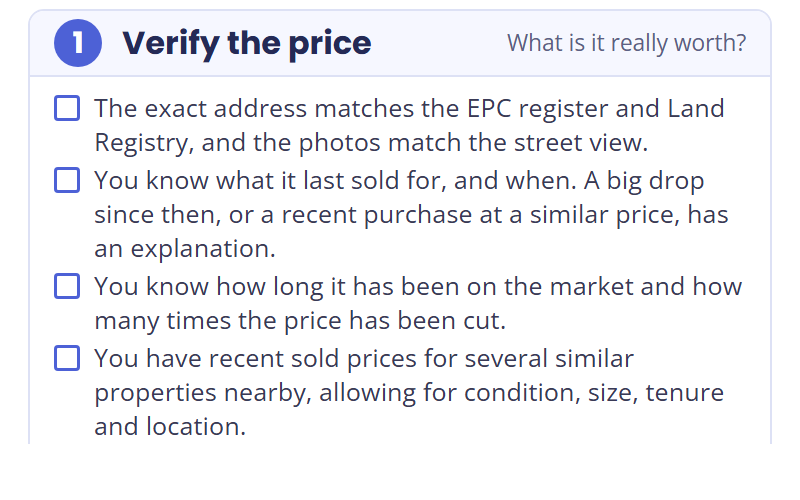
7 Step Test Investor Checklist
- Use it
- At the viewing, and before you make an offer.
- It answers
- What should I check?
- You get
- A two-page printable PDF with tick boxes and questions to ask the agent.
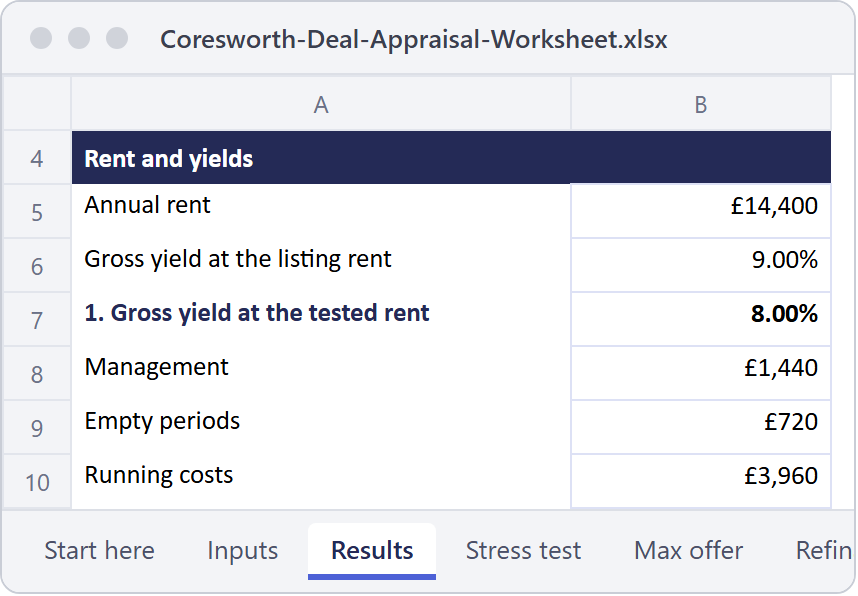
Deal Appraisal Worksheet
- Use it
- Once you have the price, the rent and your costs.
- It answers
- What do the numbers say, and what is the most I should pay?
- You get
- An Excel worksheet, filled in with an example, and a four-page how-to guide.
Both are free, and each asks for your name and email so we can send it to you.
Five Questions Before You Rely on a Stress Test
Ask these before you offer
Five questions before you rely on a stress test.
- What happens to my cash flow if the rate rises by one or two percentage points?
- What happens if the rent I’m relying on turns out 10% lower?
- How many months could the property sit empty beyond what I’ve already allowed for, and could I cover that?
- Do I have a reserve for at least one unplanned repair, kept separate from my deposit?
- What interest coverage ratio will my lender actually apply to this property, at my own tax rate?
Frequently Asked Questions
What should I stress-test before I make an offer?
A higher interest rate, a lower rent, a longer void and a repair bill, tested one at a time first and then together. This is the fifth of the seven checks in How to Analyse a Property Deal Before Making an Offer.
What is an interest coverage ratio (ICR)?
It’s the measure most buy-to-let lenders use to decide whether to lend: the annual rent as a percentage of the annual interest at a stressed, notional rate rather than your actual pay rate. Lenders typically require at least 125% for a basic-rate taxpayer and 145% for a higher-rate taxpayer.
Why would a 6% mortgage rate be tested at 8%?
Regulatory guidance requires lenders to stress buy-to-let affordability at your own rate plus at least 2 percentage points, with a floor of 5.5% if that is lower. At a 6.0% pay rate, that gives a stressed rate of 8.0%, which is the rate your rent actually needs to cover for the lender’s test, not the 6.0% you’d be paying.
Does a five-year fixed rate help me pass a lender’s stress test?
Often, yes. A mortgage fixed for five years or more is usually exempt from the 2-point stress add-on, so the lender tests closer to the rate you are actually paying. This can lift a deal’s interest coverage ratio significantly, which is one reason longer fixes are popular with landlords. Exact treatment varies by lender, so confirm it with a broker.
How do I stress-test a buy-to-let bought with a repayment mortgage?
The same way, with one adjustment. These examples use interest-only borrowing so a rate change shows up purely as a change in interest. On a repayment mortgage your monthly payment already includes paying down the loan, so it starts higher than the interest-only figure here, and a rate rise pushes it higher still. Run the stress test on your actual repayment-mortgage payment at the higher rate, not the interest-only figure, remembering that part of each payment is reducing what you owe rather than money lost.
How much cash reserve should I keep for a buy-to-let?
There’s no single rule, but many experienced landlords keep three to six months of running costs and mortgage interest in reserve per property, so a bad month doesn’t force a sale or more borrowing. Decide your own figure before you buy, sized to the deal’s worst case, not just its base case.
What Does a Stress-Tested Deal Look Like?
A stress-tested deal is one where you’ve already seen the worst case in pounds, checked it against your lender’s own test as well as your own numbers, and decided in advance whether you can absorb it or walk away. Nothing is immune to a bad year, stress-testing doesn’t change that, but the deal that surprises you later is almost always the one nobody stress-tested first.
This is the fifth of seven checks in the 7-Step Test. The free checklist puts all seven on one page, and the Deal Appraisal Worksheet runs the stress test in this guide on any property you’re looking at.
Work With Coresworth
Checking a deal properly takes time, and that’s where we come in. We source properties against your written criteria and run each one through the seven checks, and you decide whether to go ahead.
Send Coresworth your investment criteriaNot sure where to look? Our outlooks for Manchester, Leeds, Liverpool, Newcastle and Oxford are already published.
This article is general information and is not investment, financial or tax advice. Interest rates, lender criteria, rents and landlord obligations can change. The worked examples are imaginary, are not forecasts, and are not assured returns or lending decisions. Investors should confirm their own tax position with their accountant and their borrowing position with a mortgage broker before committing to a purchase.
Coresworth Research writes the Propertyology series for Coresworth Properties. Figures are drawn from published sources, which are linked at the end of each article.
Sources
Each source is labelled by the kind of evidence it gives.
- Official standard. Bank of England Prudential Regulation Authority: underwriting standards for buy-to-let lending, Supervisory Statement SS13/16, which set the interest coverage ratio test, the stressed-rate requirement and the five-year fix exception. The version in force at publication is dated September 2024. A revised version, published 20 January 2026, takes effect 1 January 2027; its detail has not been reviewed for this article, so check with your broker if you are reading this after that date.
- Official rate. Bank of England: Bank Rate.
- Illustrative. Property A and Property B, their rents, costs and loans are imaginary, drawn from the worked example in How to Analyse a Property Deal Before Making an Offer, calculated by Coresworth Research 25 October 2026. The stacked stress figures and the interest coverage ratio figures in this article were calculated by Coresworth Research 10 November 2026 from the same assumptions, with lender minimums checked against current regulatory guidance the same day.
Lender criteria, interest rates and tax rules can change. Investors should carry out their own due diligence and confirm current lender and tax requirements before making investment decisions.