

By Coresworth Research, Coresworth Properties. Examples calculated October 2026.
Key Takeaways
- The rent in a listing is a hope, not evidence. Test it against what similar homes have actually let for, not what they are asking.
- A void allowance is part of the rent, not an afterthought. No property lets every week of the year, so take a realistic gap off the annual figure.
- Know your floor before you know your ceiling. The break-even rent, the figure that only covers your costs and interest, tells you how much room you really have.
This is check 2 of 7. Read the full guide, How to Analyse a Property Deal Before Making an Offer, for all seven checks and the two example properties.
The rent on a listing is the figure every other number in your deal depends on, and it’s the one most often rounded up. A few pounds a week added to the listing makes the yield look better and the mortgage easier, and nobody checks it until the tenant is in and the real figure arrives.
Get it wrong and the mistake is expensive, whether you’re about to buy or already letting the property: a mortgage that only just covers itself, a yield that looked fine on paper and never turns up in your bank account, and a gap in your own cash flow every month the tenant pays less than you planned for.
Behind the quoted rent sit two different numbers: what the property is advertised for, and what a tenant has actually agreed to pay for one like it nearby. The first comes from someone who wants your offer to look good. This guide shows how to test it, take off the void that every let property has, and find the rent you can safely plan a deal around, whether you’re buying it or already letting it.
It’s the second check in our seven-check method, set out in full in How to Analyse a Property Deal Before Making an Offer, and it uses Property A from that guide. Property A is imaginary. The listing asks £180,000 and quotes rent of £1,350 a month, which shows as a 9.00% yield. Every figure here, including the comparable rent, is an assumption we label.
Who Is Telling You the Rent?
Nobody knows what a property will really let for until a tenant signs for it. Until then you have estimates, and each one comes from someone with a different interest.
Four Views of What a Property Will Rent For
The rent in a listing is usually the first of those. That’s the figure to push on before it decides your offer.
Start With What Similar Homes Have Actually Let For
An asking rent tells you what a landlord hopes to get. A letting portal’s price filter will mix properties still advertised with ones already let, so look for the evidence that a tenant actually agreed to pay it:
- Find similar homes that have recently let, not ones still on the market. Match the type, bedrooms, size, condition and area.
- Ask local letting agents what they are actually achieving, and how long similar properties took to find a tenant.
- Check the ONS private rent figures for the area as a wider benchmark. They cover rents across the whole private rented sector, including tenancies already running, so they tell you about the area rather than about this property on a new letting. Weigh them below a recently agreed rent on a genuinely comparable property, and above the asking rent on a listing still on the market.
- Build a range: a cautious rent, a middle rent and an optimistic one. If they’re far apart, find out why before you choose one.
When you call an agent, ask them directly: what rent have they actually achieved on comparable properties recently, how long did those properties take to let, did any need a rent reduction to find a tenant, and what kind of tenant is actually renting in this area right now. Their answers tell you far more than their first quoted figure.
A listing that has sat unlet for weeks, or had its rent cut, is telling you something the headline figure doesn’t. Ask the agent how long it’s been up and whether the price has moved.
Take Off the Void
A rent that’s never actually paid doesn’t help you. Every let property sits empty between some tenancies, while it’s cleaned, re-let or caught up in a gap you didn’t plan for, and that time earns nothing.
Here’s Property A. The listing quotes £1,350 a month. Local agents say similar properties are letting for £1,200 a month, which is an assumption for this example. A 5% void allowance, about eighteen days a year, is used here to show the effect of a rental gap. It isn’t an industry standard, so base your own figure on local letting evidence: how long similar homes are taking to re-let, and the tenant turnover you’d expect for this property.
Property A: What the Rent Actually Delivers
Swipe sideways to read across.
| Step | Monthly rent | Annual rent | Gross yield on £180,000 |
|---|---|---|---|
| The listing’s quoted rent | £1,350 | £16,200 | 9.00% |
| What local agents say similar homes are achieving | £1,200 | £14,400 | 8.00% |
| After a 5% void allowance, about eighteen days a year | £1,140 | £13,680 | 7.60% |
Illustrative only. Property A is imaginary. The listing rent and the comparable rent are assumptions for this example, drawn from How to Analyse a Property Deal Before Making an Offer. A 5% void allowance is used here to show the effect of a rental gap. It isn’t an industry standard or a forecast for any property, so base your own figure on local letting evidence and how long similar homes are taking to re-let.
One check and a void allowance take the quoted yield from 9.00% to 7.60%. The listing’s £1,350 a month was never tested against anything. The £1,200 a month local agents are actually achieving is, and even that figure earns nothing for roughly eighteen days a year. Both figures are gross yields, rent divided by price, before any running costs come off. The main guide’s operating yield, which does take those costs off, is lower again, so say which figure you’re quoting before you compare two properties.
From Advertised Rent to Break-Even Rent
Property A. Each bar is the rent at that step, as a share of the listing’s quoted £1,350 a month.
The gold line is the listing’s quoted rent of £1,350 a month. Every bar in this example falls short of it.
Property A is imaginary and every figure in it is an assumption.
The 9.00% on the listing was never the number to plan around, and none of this makes Property A a bad property. The real question is what rent you can rely on, and we find that figure below.
Ask Who’s Really Going to Pay It
A quoted rent can be true and still mislead you, because it was measured on a different basis to the one you’re planning to let under. Find out what sits behind the figure before you count on it.
Six Reasons a Quoted Rent Doesn’t Hold Up
Swipe sideways to read across.
| The reason | What it can mean | What to check |
|---|---|---|
| It’s the asking rent, not an achieved one | No tenant has agreed to pay it yet | Recently let, not just listed, comparables, and how long the current listing has been up |
| It assumes no void | The rent is quoted as if the property lets every week of the year | A void allowance built from local evidence, and how long similar homes took to find a tenant |
| It’s priced as a short let | Nightly or weekly rates, annualised, look far higher than a long tenancy would achieve | Whether the figure is a long-let rent or a short-stay rate |
| It includes bills or furniture | An all-inclusive rent isn’t the same figure as an unfurnished, bills-excluded let | What the comparable actually includes |
| It’s priced per room, not per property | A shared-house room rate quoted as a single-let rent overstates what one tenant will pay | Whether the property lets as a whole or room by room |
| It’s an old or one-off comparable | Rents move, and a single letting agreed months ago may not hold today | The date of the comparable and how the area has moved since |
General guidance, not advice for any individual investor. Rents and letting demand vary by property and by area, so check the exact address.
A tenant matters as much as a rent figure. Families, professionals and students pay different rents, leave different gaps between tenancies and need different amounts of your time, and a comparable let to the wrong kind of tenant isn’t really comparable at all.
Check the Number Your Lender Will Lend Against
If you’re borrowing, your lender tests the rent against the mortgage before they’ll lend, using their own stress rate and cover ratio, not the figure on the listing. Ask your broker what rent they’d accept and what they’d lend against it before you offer. Our guide covers the same point under Stress-Test the Figures.
Find the Rent You Can Safely Assume
Work backwards. Decide the rent you’d stake the deal on, then check it against the floor: the rent that only covers your running costs and your mortgage interest, with nothing left over.
Property A: Four Rents, and What Each One Tells You
Swipe sideways to read across.
| Rent assumed | Annual rent | Gross yield | What the figure tells you |
|---|---|---|---|
| £1,350 a month, the listing | £16,200 | 9.00% | Not yet evidenced by anyone |
| £1,200 a month, local agents’ evidence | £14,400 | 8.00% | Matches what similar homes have actually let for |
| £1,140 a month, after a 5% void allowance | £13,680 | 7.60% | The rent this property is likely to deliver across a full year |
| £971 a month, the break-even rent at 6.0% interest | £11,652 | 6.47% | Covers running costs and interest and leaves nothing over, the floor, not a target |
Illustrative only. The break-even rent is the rent that covers running costs and mortgage interest and leaves nothing over, from the stress test in How to Analyse a Property Deal Before Making an Offer. It assumes a £135,000 interest-only loan at 6.0% (£8,100 a year in interest), plus running costs of £1,800 a year in maintenance, insurance and compliance, and a further 15% of the rent itself in management and the void allowance. It excludes capital repayments, because the loan is interest-only, and excludes tax. It rises to £1,103 a month if interest moves to 7.0%. Every figure is an assumption, so check the current rates and rents before you rely on any of them.
Plan around £1,140 a month unless you have direct evidence of more, and treat £971 as the floor. Go below that and the property stops paying for its own costs and interest, before you’ve taken a penny out of it. The listing’s £1,350 was never close to either number.
The £971 comes from Property A’s own numbers in the main guide: a £135,000 loan, paying interest only so none of it is being repaid, at an assumed 6.0%, costs £8,100 a year. Running costs add £1,800 a year in maintenance, insurance and compliance, plus management and the void allowance together worth 15% of the rent. The figure excludes capital repayments, because the loan is interest-only, and it excludes tax. Reaching it only tells you where the costs stop and the loss starts, not whether a property is a good investment. You still need a rent with room above it, and a return once tax is accounted for.
Two Free Tools, Two Jobs
Use them in order. The checklist tells you what to look for, and the worksheet turns what you find into numbers.
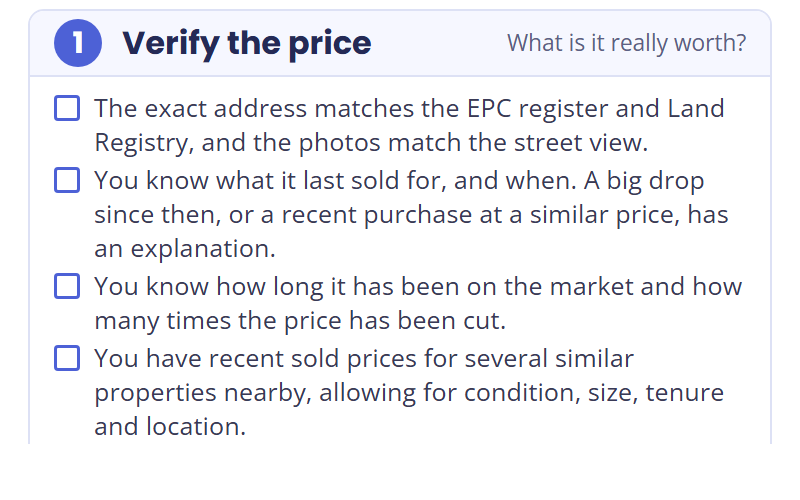
7 Step Test Investor Checklist
- Use it
- At the viewing, and before you make an offer.
- It answers
- What should I check?
- You get
- A two-page printable PDF with tick boxes and questions to ask the agent.
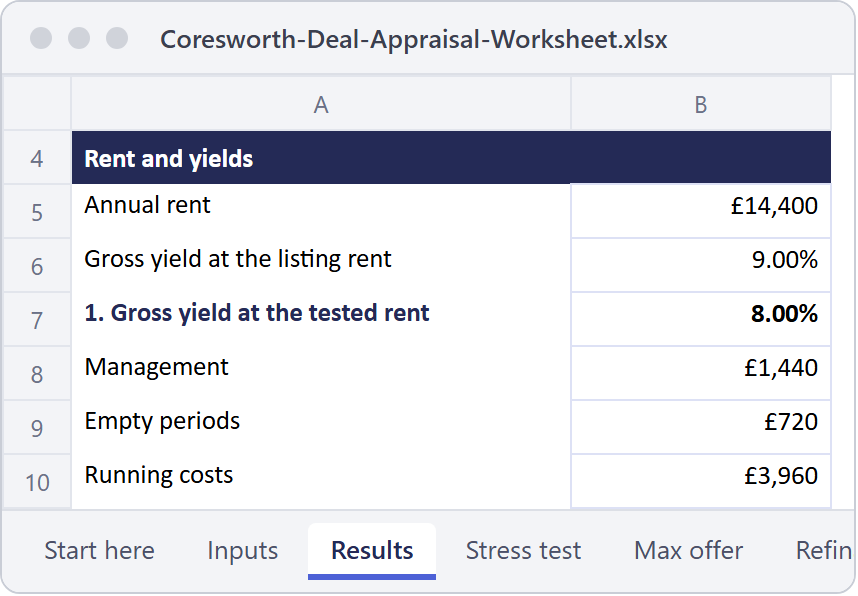
Deal Appraisal Worksheet
- Use it
- Once you have the price, the rent and your costs.
- It answers
- What do the numbers say, and what is the most I should pay?
- You get
- An Excel worksheet, filled in with an example, and a four-page how-to guide.
Both are free, and each asks for your name and email so we can send it to you.
Five Questions for Any Quoted Rent
Ask These Before You Offer
Five questions for any quoted rent.
- Is this rent currently being achieved, or only advertised?
- What do recently let, comparable properties actually rent for?
- What void allowance have I assumed, and is it realistic for this area and tenant?
- Does the quoted rent include bills, furniture or a letting model different from the one I plan to run?
- What rent, and what loan, will my lender actually accept?
Frequently Asked Questions
What is the difference between asking rent and achieved rent?
Asking rent is what a landlord or agent is advertising a property for. Achieved rent is what a tenant has actually agreed to pay, either for that property once it has let, or for a comparable one nearby. Achieved rent is the stronger evidence, because asking rent hasn’t been tested yet.
How do I find out what a property will really rent for?
Ask local letting agents what they are actually achieving on similar homes, look for recently let rather than still-advertised comparables, and check the ONS private rent figures for the area as a sense check. Build a cautious, a middle and an optimistic figure, and plan around the cautious one.
What void allowance should I use?
There is no single figure that fits every property. Ask local agents how long similar homes are taking to re-let, and use their evidence rather than a rule of thumb. A property in high demand may let faster, and one with a narrow tenant pool may sit empty for longer.
Should I trust the rent figure in a listing?
Treat it as a starting point, not a fact. It’s set by whoever wants your offer to look good, and it hasn’t been tested by a tenant. Check it against recently let comparables and the void you’re likely to see before you plan a deal around it.
What happens if the achievable rent turns out lower than the advertised figure?
Go back to your numbers before you go back to the agent. Recalculate the yield, the cash flow and the price at the lower rent, and check whether the deal still meets your own minimum return. Often the fix is a lower offer rather than a different property: the seller’s price was set against a rent that was never tested.
What Does a Realistic Rent Look Like?
A realistic rent is the one left after you’ve checked it against recently let comparables, not advertised ones, and taken off a void allowance built from local evidence. It holds up whether a tenant signs next week or next month, and it still leaves something once your costs and your mortgage interest are paid. The figure on the listing is where your checking starts, never where it ends.
This is the second of seven checks in the 7-Step Test. The free checklist puts all seven on one page, and the Deal Appraisal Worksheet does the sums for any property you’re looking at.
Work With Coresworth
Checking a deal properly takes time, and that’s where we come in. We source properties against your written criteria and run each one through the seven checks, and you decide whether to go ahead.
Send Coresworth your investment criteriaNot sure where to look? Our outlooks for Manchester, Leeds, Liverpool, Newcastle and Oxford are already published.
This article is general information and is not investment advice. Rents, void periods, borrowing costs, tax rules and landlord obligations can change. The worked example is imaginary, is not a forecast, and is not an assured return. Investors should carry out their own due diligence and obtain appropriate legal, tax, mortgage, planning and licensing advice before committing to a purchase.
Coresworth Research writes the Propertyology series for Coresworth Properties. Figures are drawn from published sources, which are linked at the end of each article.
Sources
Each source is labelled by the kind of evidence it gives.
- Official statistics. Office for National Statistics: Private rent and house prices, UK (rents actually paid, by area).
- Illustrative. Property A, its rent and the comparable rent are imaginary, drawn from the worked example in How to Analyse a Property Deal Before Making an Offer, calculated by Coresworth Research 25 October 2026. The void allowance, the net rent and the break-even figures in this article were calculated by Coresworth Research 3 November 2026 from the same assumptions.
Rental data, void risk and lender criteria can change. Investors should carry out their own due diligence before making investment decisions.