

By Coresworth Research, Coresworth Properties. Examples calculated November 2026.
Key takeaways
- The valuation decides your loan-to-value ceiling, not your hoped-for figure. A lender’s own valuer, not the agent’s guess, sets what 75% of the property is worth.
- Your rent can cap the loan below that ceiling. The same interest coverage ratio that decides whether you can borrow at all also decides how much of a refinance it will support.
- A six-month wait before a lender will use the new value is normal, not a fault. Build your bridge and your timetable around it, not around the refurbishment period alone.
This is check 6 of 7. Read the full guide, How to Analyse a Property Deal Before Making an Offer, for all seven checks and the refurbish-and-refinance example this article builds on.
A BRRR deal, buy, refurbish, rent, refinance, is sold on one promise: do the work, then pull your cash back out by refinancing against the higher value. Most of what gets written about that promise stops at the valuation, and that is the refinance trap. Two more tests stand between you and your money, and either one can leave far more cash stuck in the deal than the valuation alone suggests.
Miss them and you find out the expensive way, months after you’ve already committed the cash to the works. Spend fifteen minutes on the numbers below instead, before you buy, and you’ll know which of the three traps your deal is actually exposed to, and roughly how much it could cost you.
It’s the sixth check in our seven-check method, set out in full in How to Analyse a Property Deal Before Making an Offer, which asks what you’d do if you needed to refinance. This article goes deep on that one question, using the same refurbish-and-refinance example from that guide: buy for £150,000, spend £25,000 on works and £11,000 on stamp duty and fees, a total project cost of £186,000, aiming for a post-works value of £220,000. Every figure here, including the rent, the stress rate and the fees, is an assumption we label.
Three Tests Your Cash Has to Clear
Each one works independently of the other two, and any one of them on its own can shrink the cheque that comes back.
- The valuation. A lender’s own valuer decides what the property is worth, not the agent, not the vendor, and not you.
- The rent. The same kind of test that decided how much you could borrow to buy the property also decides how much a refinance will support, and it can cap the loan below what the valuation would otherwise allow.
- The timetable. Most lenders make you wait before they’ll lend against the new value at all, whatever the valuer says it’s worth today.
The Valuation Trap
This is the one most investors already expect. A surveyor’s figure, not your own estimate of what the works are worth, sets the 75% loan-to-value ceiling the lender will lend against.
A refinance at two valuations
Swipe sideways to read across.
| Item | If the valuation is £220,000 | If it is £205,000 |
|---|---|---|
| Purchase price | £150,000 | £150,000 |
| Works | £25,000 | £25,000 |
| Stamp duty and fees | £11,000 | £11,000 |
| Total project cost | £186,000 | £186,000 |
| Loan-to-value cap, 75% of the valuation | £165,000 | £153,750 |
| Cash left in the deal, valuation alone | £21,000 | £32,250 |
Illustrative only, reused unchanged from the refurbish-and-refinance example in How to Analyse a Property Deal Before Making an Offer. The 75% loan-to-value cap is an assumption, and a lender may lend differently. The example ignores finance costs and the time the work takes, both covered later in this article.
A £15,000 gap between a hoped-for £220,000 and a more cautious £205,000 valuation costs £11,250 in cash that stays in the deal rather than coming back to you, purely from the lower loan-to-value figure it supports. Commissioning an independent valuation before you buy, and photographing the property before and after the works, gives a surveyor evidence for the uplift rather than asking them to take your word for it.
One assumption sits behind every cash-left figure in this article: the £186,000 project cost is treated as cash you put in yourself. If you funded any of it with a mortgage or a bridge, that borrowing is redeemed first, and the costs of redeeming it, covered later in this article, come off before anything reaches your account. What a lender will advance and what actually lands in your bank account are related, but they’re not automatically the same number.
The Rent Trap
What the lender’s rent test checks on a refinance
The same interest coverage ratio, applied again at the new loan amount.
- Interest coverage ratio (ICR)
- The annual rent as a percentage of the annual interest at the lender’s stressed rate, exactly as on a purchase.
- What changes on a refinance
- The loan amount being tested is the one your valuation would support, not the one you originally borrowed to buy the property.
- Usual minimum ICR, basic-rate taxpayer
- 125% of the stressed interest payment. A market practice figure, not a fixed number set by the regulator.
- The rent-based cap
- The largest loan the rent will support at that minimum: the annual rent, divided by 1.25, divided by the stressed rate.
- What a lender actually offers
- The lower of the valuation-based cap and the rent-based cap, whichever one binds.
The interest coverage ratio that decides how much you can borrow to buy a property, covered in full in our guide to stress-testing a buy-to-let before you offer, doesn’t disappear once you own it. It runs again at refinance, against the rent the property actually earns, and it can cap the loan below the valuation-based ceiling without the valuation changing at all.
Take the same example and add a rent. An optimistic figure, the kind a sourcing agent’s listing might suggest, has this property letting for £1,400 a month. A more conservative figure, built from comparable lets rather than a guess, has it at £1,150. Run both against the usual 125% minimum, at an assumed 6.0% pay rate stressed to 8.0%, the same assumptions as our stress-test guide.
The rent cap against the valuation cap, four ways
Swipe sideways to read across.
| Measure | £220,000, optimistic rent | £220,000, evidence-based rent | £205,000, optimistic rent | £205,000, evidence-based rent |
|---|---|---|---|---|
| Rent assumed | £1,400 pcm | £1,150 pcm | £1,400 pcm | £1,150 pcm |
| Valuation-based cap, 75% LTV | £165,000 | £165,000 | £153,750 | £153,750 |
| Rent-based cap, 125% ICR at 8.0% stressed | £168,000 | £138,000 | £168,000 | £138,000 |
| Which one binds | Valuation | Rent | Valuation | Rent |
| Loan the lender actually offers | £165,000 | £138,000 | £153,750 | £138,000 |
| Cash left in the deal | £21,000 | £48,000 | £32,250 | £48,000 |
Illustrative only. The project cost (£186,000), the two valuations and the 75% loan-to-value cap are carried through from the main guide’s example. The two rents, the 6.0% pay rate stressed to 8.0%, and the 125% minimum are a further assumption, calculated by Coresworth Research 10 November 2026. Exact stress rates, the rent a lender’s own valuer will accept, and ICR minimums are set by each lender and move with the market, so ask a broker what they would apply to the property and the loan you are looking at.
At the hoped-for £220,000 valuation with the optimistic rent, the valuation is still the binding limit, and £21,000 stays in the deal, exactly as the main guide’s example shows. Swap in the more defensible, evidence-based rent and the rent test becomes the binding limit instead, at both valuations, and £48,000 stays in rather than £21,000 or £32,250. The valuation told you the property was worth £220,000. The rent is what told you that you couldn’t actually borrow against all of it.
Your Fix Length Changes This Test Too
A mortgage fixed for five years or more is usually exempt from the 2-point stress add-on, which we covered as a way to pass a lender’s test on the way in. It can also change how much cash a refinance gives back.
The same rent, stressed at two rates
Swipe sideways to read across.
| Measure | Stressed at 8.0%, most fixes | Stressed at 6.0%, fixed 5 years or more |
|---|---|---|
| Rent-based cap, evidence-based rent | £138,000 | £184,000 |
| Binding cap at the £220,000 valuation | £138,000, rent binds | £165,000, valuation binds |
| Cash left in the deal at £220,000 | £48,000 | £21,000 |
| Binding cap at the £205,000 valuation | £138,000, rent binds | £153,750, valuation binds |
| Cash left in the deal at £205,000 | £48,000 | £32,250 |
Illustrative only, using the same £1,150 a month evidence-based rent throughout. A mortgage fixed for five years or more is usually exempt from the 2-point stress add-on, so it is tested closer to the rate you are actually paying, here assumed at 6.0%. Exact treatment varies by lender, so confirm it with a broker before relying on it.
Stressed at 8.0%, the evidence-based rent in our example caps the loan at £138,000 and leaves £48,000 in the deal. Stressed at 6.0%, because the new mortgage is fixed for five years or more, that same rent supports £184,000, enough that the valuation becomes the binding limit again and the cash left in the deal drops back to £21,000 or £32,250. The length of the fix you choose at refinance can be worth tens of thousands of pounds, on exactly the same property, with exactly the same rent. Exact stress rates and ICR minimums are set by each lender and move with the market, so ask a broker what they’d apply to the loan you’re actually looking at.
The Timing Trap
Even a valuer who agrees with you, and a rent that comfortably clears the test, don’t help if the lender won’t act on either yet.
When a lender will actually let you refinance at the new value
The six-month rule, and its usual exception.
- Most residential buy-to-let lenders
- Require six months of ownership before they’ll remortgage at the new, post-works value, so the deposit and the refurbishment cost stay tied up for that period regardless of how quickly the value has been proven.
- HMO and other commercial finance
- Usually lent against a multiple of rental income rather than bricks-and-mortar value. Some lenders in this space will remove the wait, letting recycling happen in as little as two or three months, but this is a lender-by-lender decision, not a general entitlement.
- Before you commit to a bridge
- Both the six-month rule and its exceptions vary by lender and shift as the mortgage market changes, so confirm the actual wait with your broker before you set a refurbishment and bridging timetable around it.
Plan your bridge around this. A bridge that was sized to the refurbishment period alone, with no allowance for the wait before a residential lender will refinance at the new value, runs on at bridging rates while you wait, which is its own cost, covered next.
What a Refinance Actually Costs
The headline figures above are before the costs of actually doing it.
What comes out before you see the cash
The costs a refinance carries that a straight purchase doesn’t.
- A second valuation
- The lender needs its own survey of the finished property, at your cost, on top of the one you paid for when you bought it.
- A second set of legal and arrangement fees
- Refinancing is a new mortgage application, with its own legal fees and, often, its own arrangement fee.
- Bridging costs, if you used a bridge
- Monthly interest, an arrangement fee, and on some bridges a minimum term that charges you for months you didn’t use, plus an exit fee when you repay.
- Early repayment charges, if you’re replacing an existing mortgage
- Some fixed and tracker deals charge a percentage of the balance for repaying early. Check your current mortgage’s terms before you refinance it.
None of these numbers are large on their own. Added together, and added to whichever of the valuation or the rent test bound your loan, they’re the difference between the figure in your spreadsheet and the figure that actually lands in your account.
Two free tools, two jobs
Use them in order. The checklist tells you what to look for, and the worksheet turns what you find into numbers, including the exit and refinance figures in this article.
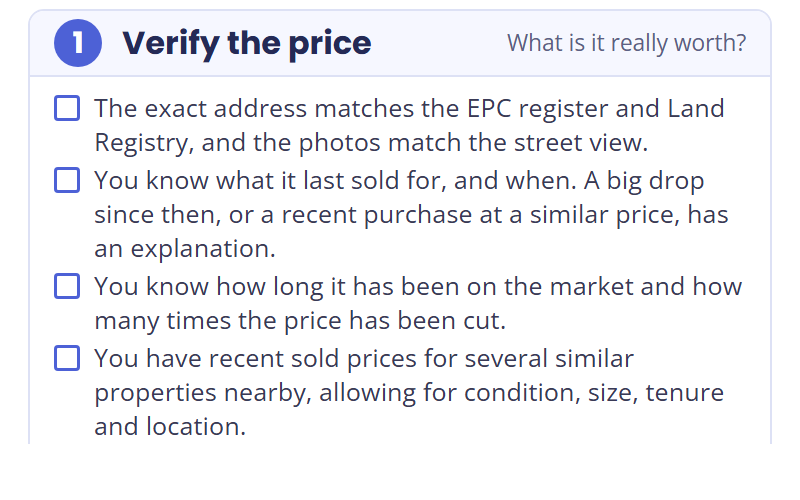
7 Step Test Investor Checklist
- Use it
- At the viewing, and before you make an offer.
- It answers
- What should I check?
- You get
- A two-page printable PDF with tick boxes and questions to ask the agent.
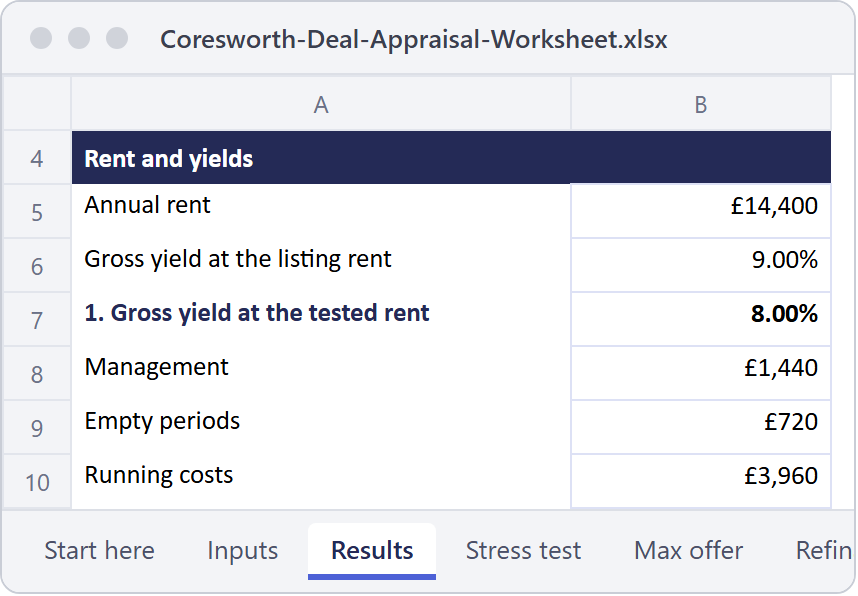
Deal Appraisal Worksheet
- Use it
- Once you have the price, the rent and your costs.
- It answers
- What do the numbers say, and what is the most I should pay?
- You get
- An Excel worksheet, filled in with an example, and a four-page how-to guide.
Both are free, and each asks for your name and email so we can send it to you.
Six Questions Before You Rely on a Refinance
Ask these before you rely on a refinance
Six questions before you rely on a refinance.
- Does the post-works valuation have comparable evidence behind it, not just your own guess?
- Is the rent you’re relying on an evidence-based figure, or an optimistic one from a listing?
- Have you confirmed your lender’s actual interest coverage ratio, stress rate and ownership-period rule with a broker?
- Have you included every cost of refinancing, not just the headline arrangement fee?
- If you used a bridge or an existing mortgage, have you worked out exactly what redeeming it will cost?
- Does the deal still work if the valuation or the rent comes in lower than you hoped?
Frequently Asked Questions
What is the refinance trap in a BRRR deal?
Assuming the loan-to-value figure on the valuation is the only thing that decides how much cash comes back out. In practice, the lender’s own rent test and the minimum time it will wait before lending against the new value can each cap the loan further, sometimes well below what the valuation alone would support.
How much of my deposit actually comes back out after a refinance?
Whichever is lower of the loan-to-value cap on the surveyor’s valuation and the loan the rent will support at the lender’s minimum interest coverage ratio, minus the costs of the refinance itself. Test both before you buy, not just the valuation.
What is a lender’s rent test on a refinance?
The same interest coverage ratio used on a purchase, covered in full in our guide to stress-testing a buy-to-let, run again at the new loan amount: the annual rent as a percentage of the annual interest at the lender’s stressed rate, usually needing to clear 125% for a basic-rate taxpayer.
Why do some lenders need six months before they’ll remortgage at the new value?
Most residential buy-to-let lenders require six months of ownership before they’ll lend against a property’s current value rather than its purchase price. HMO and other commercial finance, usually lent against rental income rather than bricks-and-mortar value, often removes this wait. Confirm current criteria with your broker, since both the rule and its exceptions vary by lender.
Does a five-year fixed rate help me get more cash back on a refinance?
It can. A mortgage fixed for five years or more is usually exempt from the 2-point stress add-on, so the lender’s rent test is run at a lower stressed rate. Where the rent test is the binding constraint, that can raise the rent-based cap enough to let the valuation become the limit again, releasing more cash. Confirm the treatment with a broker, since it varies by lender.
What costs come out of a refinance before I see any cash?
A second valuation, a second set of legal fees, often a second arrangement fee, and, if you used one, the interest, arrangement fee and any exit or minimum-term charges on your bridging loan. All of these reduce the cash that actually reaches you below the headline figure the loan-to-value or rent calculation suggests.
What Does a Refinance That Actually Pays You Back Look Like?
One where you’ve tested the valuation against real comparable evidence, tested the rent against the lender’s own ICR rather than the figure you’re hoping for, and built your bridge around the wait most lenders impose rather than the refurbishment period alone. Any one of the three can cap what comes back. A BRRR deal that works on all three, not just the one you happened to check, is the one that gives you your deposit back to do it again.
This is the sixth of seven checks in the 7-Step Test. The free checklist puts all seven on one page, and the Deal Appraisal Worksheet runs these numbers on any property you’re looking at.
Work With Coresworth
Checking a deal properly takes time, and that’s where we come in. We source properties against your written criteria and run each one through the seven checks, and you decide whether to go ahead.
Send Coresworth your investment criteriaNot sure where to look? Our outlooks for Manchester, Leeds, Liverpool, Newcastle and Oxford are already published.
This article is general information and is not investment, financial or tax advice. Interest rates, lender criteria, valuations and refinancing rules can change. The worked examples are imaginary, are not forecasts, and are not assured returns or lending decisions. Investors should confirm their own borrowing position with a mortgage broker and their tax position with their accountant before committing to a purchase or a refinance.
Coresworth Research writes the Propertyology series for Coresworth Properties. Figures are drawn from published sources, which are linked at the end of each article.
Sources
Each source is labelled by the kind of evidence it gives.
- Official standard. Bank of England Prudential Regulation Authority: underwriting standards for buy-to-let lending, Supervisory Statement SS13/16, which set the interest coverage ratio test, the stressed-rate requirement and the five-year fix exception, reused here for the rent test on a refinance. The version in force at publication is dated September 2024. A revised version, published 20 January 2026, takes effect 1 January 2027; its detail has not been reviewed for this article, so check with your broker if you are reading this after that date.
- Illustrative. The purchase price, works, fees and the two valuations are the refurbish-and-refinance example from How to Analyse a Property Deal Before Making an Offer. The rent figures, the stress rate and the costs of refinancing in this article are a further assumption, calculated by Coresworth Research 10 November 2026, with lender practice on seasoning periods and refinance valuations checked against current guidance the same day.
Lender criteria, interest rates and refinancing rules can change. Investors should carry out their own due diligence and confirm current lender requirements before making investment decisions.