


A data‑driven framework for identifying resilient markets, pricing risk, and allocating capital with confidence
The UK housing market investment framework is often described as unpredictable — but for investors, it is one of the most structurally consistent asset classes in the economy. Prices and rents move in cycles, but the underlying drivers are stable:
Demand grows quickly. Supply grows slowly. The gap between them creates long‑run value.
This housing market investment framework gives investors a clear, analytical framework to understand where opportunities lie, where risks are rising, and how to position capital for the next decade
Structural Undersupply — The Foundation of Long‑Run Value
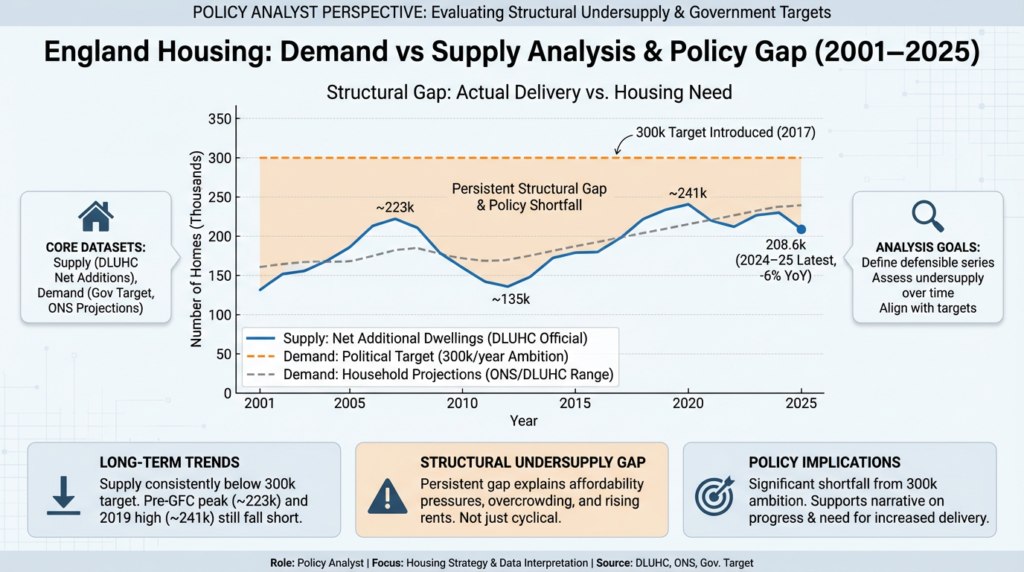
England needs around 300,000 homes per year (government ambition).
It delivers 200,000–250,000 (DLUHC Net Additional Dwellings).
This gap has persisted for decades.
Even during downturns — 2008–09, 2023–24 — supply does not surge.
Developers slow down, planning delays increase, and viability weakens.
SO WHAT FOR INVESTORS?
- Undersupply supports long‑run capital growth.
- Undersupply supports rental inflation.
- Undersupply reduces downside risk during downturns.
- Markets with the tightest supply constraints outperform over time.
This diagram illustrates the long‑running gap between the number of homes England actually delivers each year and the level of housing need implied by government targets and household projections. The blue line shows net additional dwellings, which have consistently remained below both the 300,000‑homes‑per‑year ambition and the underlying demographic demand. Even in peak years, supply never reaches the target, creating a persistent structural shortfall. This widening gap helps explain rising affordability pressures, overcrowding and rental inflation — and shows that the UK’s housing challenge is not cyclical, but rooted in long‑term undersupply.
Rental Growth vs Supply — The Core Investor Signal
Rental markets tighten when:
- Tenant demand rises (jobs, migration, household formation)
- New‑build delivery falls
- Landlord exits reduce rental stock
- Planning constraints limit expansion
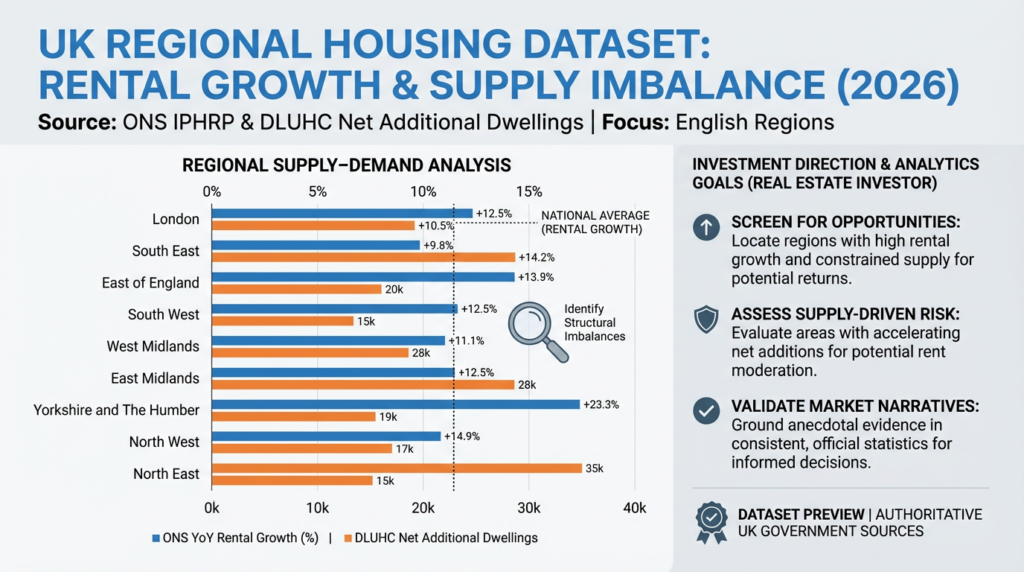
Regions with high rental growth + low new‑build delivery show the strongest fundamentals.
SO WHAT FOR INVESTORS?
These regions offer:
- Stronger rental inflation
- Lower void risk
- More resilient yields
- Better long‑term capital performance
This diagram compares regional rental growth with the number of new homes delivered each year, highlighting where demand is rising faster than supply. By placing ONS rental inflation alongside DLUHC net additional dwellings, the chart reveals which regions face the greatest supply–demand pressure and where rental markets are tightening most sharply. The visual helps readers understand why some areas experience rapid rent increases while others remain more balanced, offering a clear, data‑driven view of regional housing dynamics.
Regional Imbalances — Where the Opportunities Really Are
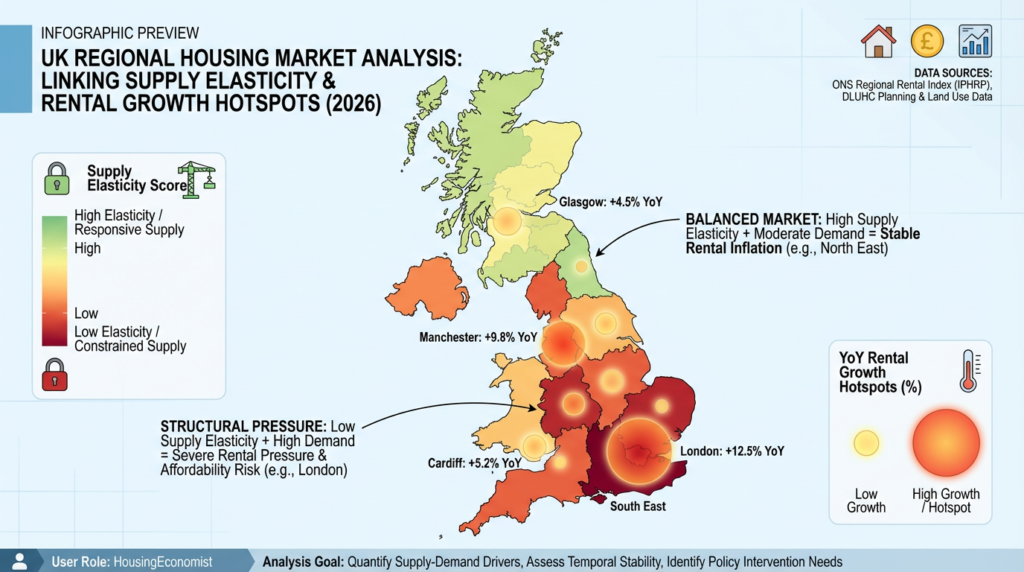
The UK is not one market. It is dozens of micro‑markets with different supply constraints and demand drivers.
Regions with strong fundamentals (tight supply + strong demand):
• London — extreme supply constraints, global demand
• South East — high incomes, limited land
• Bristol — strong jobs, constrained geography
• Manchester — regeneration + population growth
• Oxford/Cambridge — knowledge‑economy hubs
Read our Oxford 2026 Case Study
Regions with improving fundamentals (growth + affordability):
• North West — strong rental growth, moderate supply
• West Midlands — rising demand, limited new‑build
• Yorkshire & Humber — affordability + inward migration
Regions with weaker fundamentals (elastic supply):
• Some towns in the Midlands and North East
• Areas with large new‑build pipelines
• Locations dependent on single industries
SO WHAT FOR INVESTORS?
Capital should follow structural tightness, not just headline yields.
The diagram maps rental‑growth hotspots onto regional supply‑elasticity scores to show where demand pressure is colliding with constrained housing supply. Regions shaded red have low supply elasticity, meaning they struggle to build enough homes, while the overlaid circles highlight where rents are rising fastest. Together, the visual reveals the areas facing the greatest structural pressure — such as London and parts of the North West — and contrasts them with more balanced markets where supply can respond more easily to demand.
HPI vs CPI — Why UK Property Outperforms Inflation
Over the past 25–30 years:
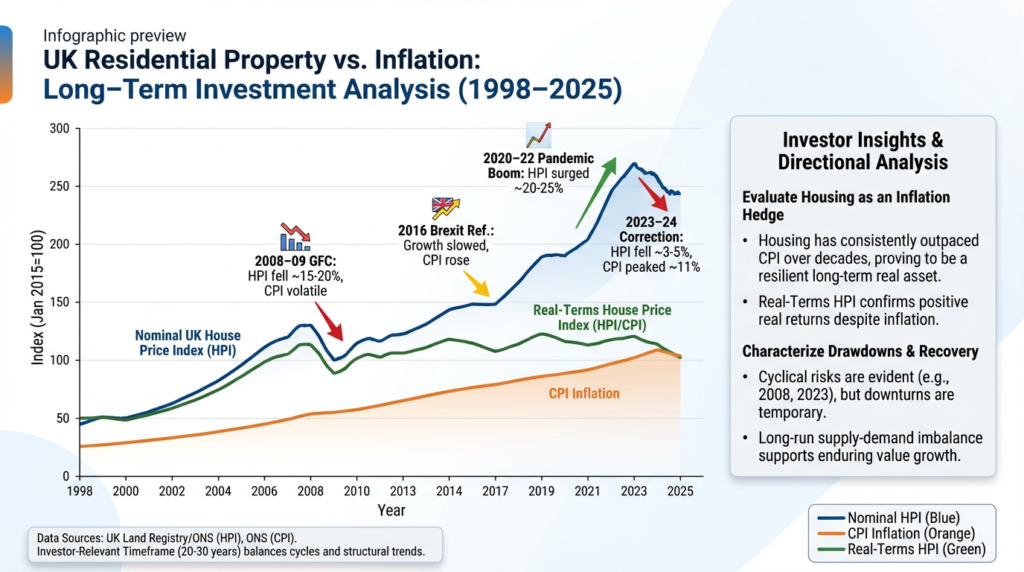
• Nominal HPI has risen strongly
• CPI inflation has risen steadily
• Real‑terms HPI (HPI ÷ CPI) has still increased significantly
This shows that UK housing is a long‑run inflation‑beating asset.
SO WHAT FOR INVESTORS?
• Property protects capital in real terms
• Real‑terms growth compounds over decades
• Downturns are temporary; structural drivers persist
This diagram compares UK house prices with inflation over the past two decades, showing how property has performed both in cash terms and after adjusting for rising prices. By plotting nominal HPI, CPI inflation, and a real‑terms house‑price index, the chart highlights how major events such as the financial crisis, Brexit and the pandemic shaped the market. The visual makes clear that, despite cyclical downturns, UK housing has consistently outpaced inflation over the long run, reinforcing its role as a resilient real asset.
Yield vs Capital Growth — How to Position Your Portfolio
High‑yield markets
• Often have more elastic supply
• Lower entry prices
• Higher gross yields
• But weaker long‑run capital growth
Examples:
Parts of the North East, some Midlands towns.
High‑growth markets
• Tight supply
• Strong demand
• Higher entry prices
• Lower yields
• But stronger long‑run appreciation
Examples:
London, Bristol, Manchester, Oxford.
Balanced markets
• Moderate yields
• Moderate growth
• Strong fundamentals
Examples:
North West, West Midlands, Yorkshire & Humber.
SO WHAT FOR INVESTORS?
Your strategy should match your objective:
- Income‑focused: choose elastic‑supply, high‑yield markets
- Growth‑focused: choose constrained‑supply, high‑demand markets
- Balanced: choose regions with both rental pressure and moderate supply
Investment Frameworks — How to Evaluate Any Market
Framework 1: The 3‑Pillars Model
- Population growth
- Planning constraints
- Pipeline of new supply
Markets with strong population growth + tight planning + weak pipeline outperform.
Framework 2: The Rental Pressure Score
Rental Pressure = Rental Growth (%) / Net Additions per 1,000 households
High score = tight market = strong fundamentals.
Framework 3: The 5‑Drivers of Long‑Run Value
- Jobs & wages
- Transport & connectivity
- Universities & knowledge hubs
- Regeneration
- Supply constraints
Region‑by‑Region Fundamentals (Investor Summary)
London
- Extreme supply constraints
- Strong long‑run capital growth
- Lower yields
- Global demand
South East
- High incomes
- Limited land
- Strong rental demand
North West
- Strong rental growth
- Regeneration
- Balanced yields + growth
West Midlands
- Rising demand
- Limited new‑build
- Strong rental fundamentals
Yorkshire & Humber
- Affordability
- Growing demand
- Improving fundamentals
East Midlands
- Moderate supply
- Moderate demand
- Balanced performance
Investor Checklist — Your Due Diligence Framework
✔ 1. Is rental demand rising?
ONS IPHRP, local employment data.
✔ 2. Is supply constrained?
DLUHC net additions, planning approvals.
✔ 3. What is the real‑terms price trend?
ONS HPI vs CPI.
✔ 4. What is the local pipeline?
New‑build schemes, regeneration plans.
✔ 5. What is the yield vs growth profile?
Gross yield, rental growth, capital growth.
✔ 6. What are the policy risks?
Planning reform, rental regulation, tax changes.
Conclusion: Invest Where Supply Is Tight and Demand Is Rising
The UK housing market rewards investors who understand:
- Structural undersupply
- Regional imbalances
- Rental pressure
- Long‑run real‑terms growth
- Policy constraints
- Local fundamentals
When you combine these insights, you can identify markets that offer:
- Strong rental income
- Low void risk
- Long‑run capital appreciation
- Resilience through cycles
This guide gives you the framework.
Use it to allocate capital with confidence — and ahead of the market.
Ready to scale? Learn how Property Investors are able to identify these high-pressure markets ahead of their competitors, and learn why smart property investors benefit from professional sourcing agents, to scale faster