

Railroads Revolutionised the Industrial Revolution
- They reshaped the geography of industry,
- Expanded cities, and
- Rewrote the rules of property value across Britain.
Why Railroads Mattered in the Second Industrial Revolution
- The first industrial wave was about mechanisation and steam.
- The second was about scale, systems, and connectivity.
- Electrification: A shift in industry from steam-driven power to more efficient, centralized electric motors, enabling faster production and transforming urban life.
- Steel production: revolutionized by Henry Bessemer’s 1856 invention, which enabled low-cost, high-volume production. This shift from wrought iron to durable steel, crucial for railways and shipbuilding, cemented Sheffield (”Steel City”) as a global hub
- Mass manufacturing: The transition from steam to electrical power, shifting toward steel production, chemical engineering, and automatic factories. The era was characterized by increased efficiency, lower production costs, and a move away from the domestic system towards concentrated, machine-driven production in factories
- Expanding urban markets: The United Kingdom experienced a massive expansion of urban markets driven by rapid population growth, increased real wages, and improved transportation. By 1901, 80% of the British population lived in towns, turning cities into high-density hubs of consumption and commercial activity.
Railroads Changed the Value of Location
Before rail, land value was tied to agriculture, estate ownership, and slow local markets.
After rail, the most valuable land became the land that was connected.
Land near stations, junctions, depots, and freight lines gained a premium because it could support:
- Industrial buildings
- Warehousing and distribution
- Worker housing
- Retail and commercial activity, later,
- Middle‑class suburban expansion
Investor takeaway: When transport improves, land near the network benefits first — and often the most.
Railroads Accelerated Industrial Expansion
Railroads dramatically reduced the cost and time of moving heavy materials. Steel, coal, machinery, and manufactured goods could travel in larger volumes over longer distances. This allowed factories to scale and freed them from dependence on rivers or canals.
Key shifts included:
Decentralisation from Water Sources
Factories moved away from rural rivers and mills, concentrating in urban areas with better labour access and superior transport links.
Warehouse and Hub Expansion
Massive warehouse districts emerged at railway junctions and alongside canal networks to store coal, raw materials, and finished goods.
For industrial property, rail‑access sites became highly attractive — not because they were cheap, but because they were logistically superior.
Stations Became Property Hotspots
Stations acted as economic magnets. They concentrated movement, trade, and development in one place, pulling in:
- Housing
- Shops
- Workshops
- offices
- services
Land near stations appreciated faster than surrounding plots. Investors quickly recognised that proximity to rail = higher returns.
This “station effect” still shapes modern commuter towns, regeneration zones, and transport‑led development projects.
Railroads Supported Suburban Growth
Rail travel allowed people to live farther from polluted industrial cores while staying connected to work and city life. This expanded the housing market outward from crowded centres.
Suburban land with rail access became more valuable because it offered:
- Cleaner air
- More space
- Better living conditions
- Reliable access to employment
Railroads didn’t just increase inner‑city land values — they created new value in outer districts and commuter corridors.
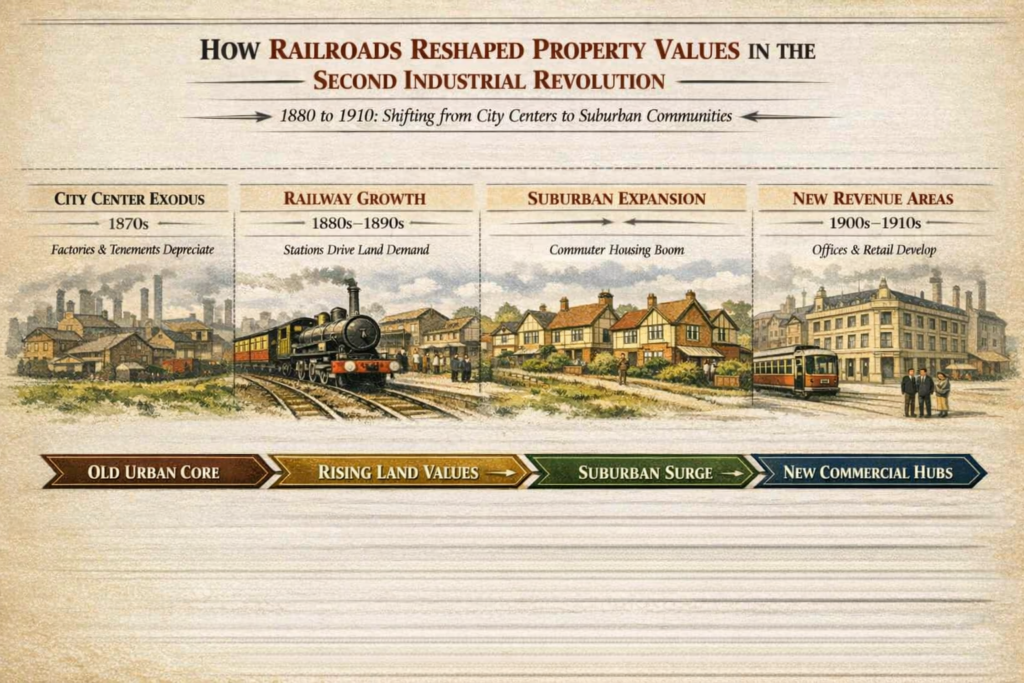
For property investors and landlords, this visual highlights how rail infrastructure during the Second Industrial Revolution (1880–1910) fundamentally reshaped land economics.As railways expanded, demand shifted away from congested industrial cores toward newly accessible suburban zones. Stations became magnets for residential development, driving up land values in surrounding areas and enabling the rise of commuter suburbs.Meanwhile, commercial hubs emerged around transport nodes, offering new revenue opportunities in retail and office space.Understanding this historical shift is essential: it established the locational premium model that still underpins modern property valuation — proximity to transport equals profitability
Railroads Reshaped the Industrial City
By the late 19th century, industrial cities had evolved into layered urban systems. Railroads linked industry, housing, and commerce into a wider metropolitan structure.
Rise of Urbanisation
Worker housing clustered near factories, creating dense industrial zones.
Growth of Specialised Districts
Rail networks enabled dedicated industrial areas for heavy engineering and manufacturing, reshaping cities like Manchester, Leeds, and Birmingham.
For property professionals, this demonstrates how transport infrastructure shapes land‑use patterns over decades — not just years.
Property Value & Appreciation:
First vs Second Industrial Revolution (UK)
| Aspect | First Industrial Revolution (c. 1760–1840) | Second Industrial Revolution (c. 1870–1914) |
|---|---|---|
| Primary Drivers of Property Demand | Proximity to water power, coal fields, and early factories | Proximity to railways, ports, electricity grids, and industrial hubs |
| Key Locations of Value Growth | Northern mill towns (e.g. Manchester, Leeds), river valleys | Major cities and suburbs (e.g. London expansion, Birmingham, Liverpool) |
| Type of Property Increasing in Value | Worker housing (often overcrowded), mills, warehouses | Suburban housing, commercial offices, improved industrial facilities |
| Speed of Appreciation | Rapid but chaotic and localized | More structured and sustained, tied to infrastructure planning |
| Urban Planning Influence | Minimal—growth was unregulated | Increasing regulation (zoning, sanitation laws, planned suburbs) |
| Living Conditions vs Value | High demand → rising prices despite poor living conditions | Value linked to quality of life improvements (sanitation, transport) |
| Transport Impact on Value | Canals and early roads created micro property booms | Railways and trams enabled commuter belts, raising suburban land values |
| Land Ownership Patterns | Wealth concentrated among industrialists and landowners | Broader middle-class property ownership begins to emerge |
| Speculation | High speculation in industrial towns, often unstable | More institutional investment (banks, developers), slightly less volatile |
| Long-Term Appreciation Trend | Many early industrial areas later declined in value | Many suburban developments retained and grew long-term value |
| Commercial Property | Factory-adjacent land highly valued | City centers saw rising office and retail property values |
| Rural vs Urban Shift | Massive rural → urban migration drove sharp urban price spikes | Continued urban growth, but decentralization into suburbs begins |
The Wider Economic Effect
Railroads powered the broader momentum of the Second Industrial Revolution. They were essential to mass production, enabling the movement of inputs and outputs at industrial scale. They also reinforced urbanisation by linking labour markets to new employment centres.
This connectivity encouraged:
- Capital investment
- Commercial expansion
- Formal property development
- The rise of building societies
- Municipal infrastructure spending
The result was a more integrated and more complex real estate market.
In simple terms: railroads made place matter in a new way.