
The Industrial Catalyst: How Infrastructure Refined UK Property Value
- They changed which locations became valuable,
- Which towns expanded, and
- Where industry and housing clustered.
For property investors and real estate professionals, this period is a useful case study in how infrastructure creates value. Land that had once been judged mainly by agricultural output or estate ownership increasingly gained value because of access, connectivity, and proximity to industrial activity.
From Agrarian Land to Transport-Led Value
Before industrialisation, most land value in Britain came from farming, estates, and local settlement patterns. Roads were often poor, travel was slow, and long-distance movement of goods was expensive and unreliable. As a result, land value was largely local and relatively static.
| Feature | Pre-Industrial Britain | Industrial Britain (Post-1760) |
| Primary Value Driver | Agricultural fertility & soil quality | Connectivity & proximity to transport |
| Transport Method | Packhorses & seasonal dirt roads | Canals, turnpikes, and steam rail |
| Value Hubs | Market towns & feudal estates | “Value nodes” around stations & docks |
| Housing Pattern | Rural, scattered cottages | Dense urban terraces & worker housing |
That changed when transport improved. Once goods, coal, workers, and finished products could move more easily, land close to transport routes began to command a premium. Access started to matter as much as fertility or inheritance.
Canals: The First Major Value Driver
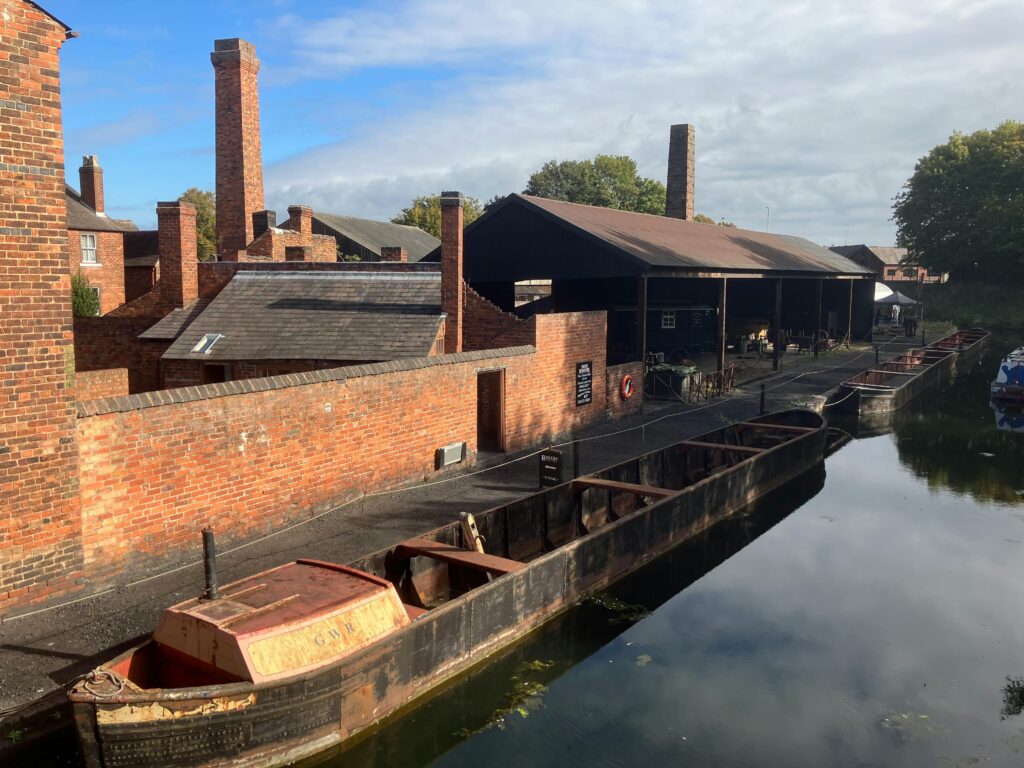
Canals were one of the earliest and most important transport innovations of the industrial age. They allowed heavy goods such as coal, raw materials, and manufactured products to move much more cheaply than by road. This was especially important for early factories, which depended on reliable access to fuel and markets.
- The Sankey Canal (Opened 1757). It connected the coalfields of St Helens to the River Mersey for export.
- The Bridgewater Canal (Opened 1761). Within a year, it reduced the price of coal in Manchester by nearly two-thirds.
- The Trent and Mersey Canal (Opened 1777). This 93.5-mile canal was England’s largest civil engineering project at the time, enabling industrialization in the Midlands.
Land near canals became more valuable because it offered lower transport costs and better commercial potential. Warehouses, mills, depots, and industrial sites naturally clustered around canal networks. In practical terms, the canal corridor became an early industrial property market.
For investors, the lesson is clear: when transport cost falls, land closest to the network gains value first.
Roads Improved Accessibility and Expanded Market Reach
Roads also played a major role in shaping property values. As road-building improved, especially through more durable surface methods, travel became easier in all weather and more predictable throughout the year. That reduced isolation and made more places viable for trade, production, and settlement.
Improved roads increased the value of towns that sat on important routes. They also made it easier for workers to travel, for goods to reach market, and for suppliers to serve industrial centres. This expanded the geography of real estate demand beyond the immediate edges of canals and factories.
- The Great North Road (London-to-Scotland road between Wadesmill and Stilton): The first turnpike Act in England, authorized in 1663, aimed at repairing the heavily used section of the road.
- The “Coal Road” (Darlington to West Auckland): Turnpike in 1751 in Durham, was crucial for connecting coal mines to the industry, reflecting the “turnpike mania” of the 1750s-70s.
- Staffordshire Pottery Roads (Burslem to Red Bull): In 1763, industrialist Josiah Wedgwood petitioned Parliament to turnpike this road, connecting the potteries to the national road network to stop the destruction of fragile goods transported by packhorse.
- Harrogate to Boroughbridge Road: Constructed by John Metcalf (also known as “Blind Jack of Knaresborough”) starting in 1765, this was an early example of using raft-like foundations over bogs to connect industrial areas in the north
Road transport mattered not just for movement, but for confidence. Once a place was easier to reach, it became easier to invest in.
Railways Transformed Station Areas
Railways took the transport revolution further than canals and roads. They dramatically reduced journey times, connected industrial centres to wider markets, and made daily movement of goods and people far more efficient. This changed property values in a very direct way.
Land near stations became especially attractive. Stations created focal points for industrial uses, worker housing, retail, and later broader urban development. Areas with rail access could support denser, more profitable land uses because they were tied into the wider economy.
- Stockton and Darlington Railway (1825): Widely considered the world’s first public railway to use steam locomotives. It proved the viability of steam-powered railways for both goods and passengers
- Liverpool and Manchester Railway (1830): The world’s first inter-city, steam-only passenger railway designed to connect two major economic centres.
- London and Birmingham Railway (1838): London’s first inter-city railway, connecting the capital to the industrialized Midlands. It shortened travel times between London and the industrial north.
- Great Western Railway (1830s–1840s): A massive, high-speed line linking London to Bristol, engineered by Isambard Kingdom Brunel. It revolutionized travel comfort and speed.
This is one of the most important transport lessons in property history: stations do not just move people. They create value nodes.
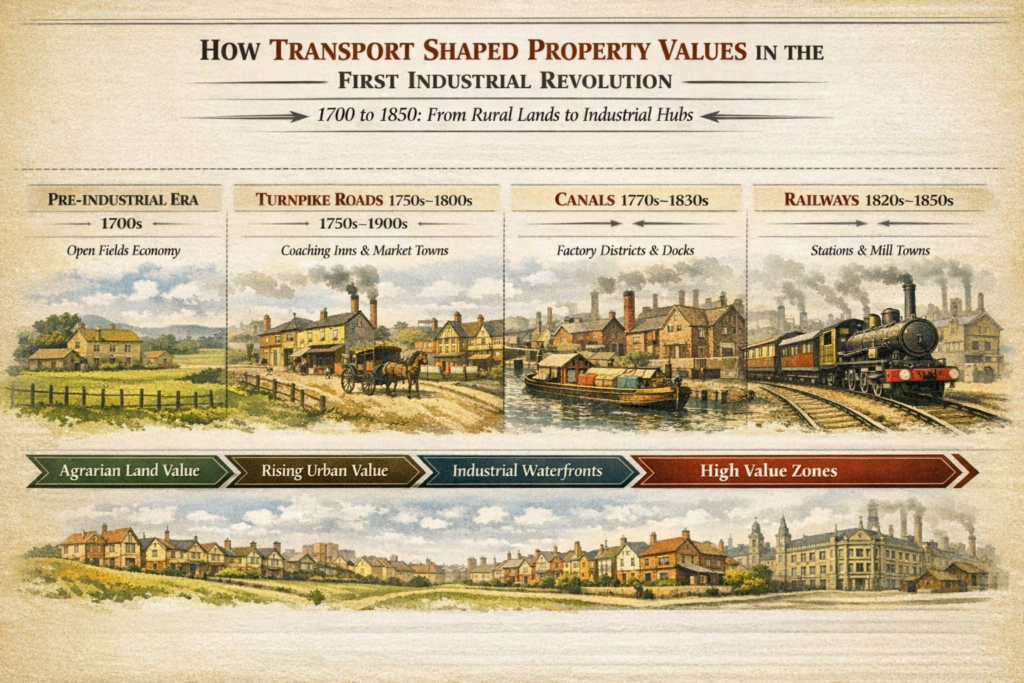
This diagram illustrates how successive waves of transport innovation reshaped land use and property values during the First Industrial Revolution.In the early 1700s, Britain’s economy was still rooted in an agrarian landscape where land value depended on farming productivity and proximity to local markets.The introduction of turnpike roads in the mid‑18th century began to shift this pattern, creating new commercial corridors around coaching inns and market towns.As canals arrived from the 1770s, industrial districts clustered along these efficient freight routes, pushing up the value of waterfront land and attracting factories, warehouses, and workers.The arrival of railways in the 1820s accelerated this transformation dramatically: stations became new urban anchors, mill towns expanded at unprecedented speed, and previously remote areas surged in value.Together, these transport revolutions redefined the geography of economic opportunity, proving that in the industrial age, infrastructure was the most powerful driver of property value.
Why Transport Increased Land Values
Transport boosted land values through several linked mechanisms:
It reduced the cost of moving raw materials and finished goods.
It improved access to labour markets.
It made industrial sites more flexible and less dependent on rivers.
It encouraged dense development near key infrastructure.
It created stronger commercial demand around routes, hubs, and nodes.
In other words, transport made land more productive in an economic sense. A field near a canal, road, or railway could suddenly become a place for housing, manufacturing, storage, or trade.
How This Changed Industrial Property
Industrial property during the First Industrial Revolution evolved rapidly. Early workshops and rural production sites gave way to larger factory complexes, warehouses, and transport-linked industrial districts. The best sites were no longer simply the cheapest or the most traditional — they were the ones best connected to movement and fuel supply.
Factories wanted to be near coal, labour, and transport. Developers wanted to be near industrial growth. Landowners who sat on the right route benefited from rising demand. Transport turned location into a competitive advantage.
Housing Followed the Transport Economy
Transport also shaped residential property. As factories and depots grew near canals and rail lines, workers needed housing nearby. This led to the rapid expansion of terraces, back-to-back homes, lodging houses, and dense urban neighbourhoods close to employment centres.
The result was a new kind of property market: one driven by industrial access rather than agricultural land. Housing values rose where transport made commuting or walking to work possible, while less connected areas often lagged behind.
For lower-income households, proximity to work was often more important than space or comfort. For middle- and upper-income groups, improved roads and rail access supported the growth of more spacious suburban housing in better-connected locations.
Pre-Industrial Britain vs Industrial Britain
The difference between pre-industrial and industrial Britain is fundamental to understanding property history.
Before industrialisation, land value was tied mainly to farming and estate control. After transport improvements, land value became much more sensitive to access, movement, and economic connection.
That shift changed the map of Britain.
- Villages became towns.
- Towns became industrial centres.
- Industrial centres became transport-led urban systems.
- Property value followed that sequence.
Why This Still Matters Today
The First Industrial Revolution shows that infrastructure is one of the strongest drivers of property value. The pattern remains the same in modern markets: places with better transport links tend to attract more demand, support more development, and hold value more effectively over time.
For real estate professionals, the lesson is practical. If transport can change the value of land so dramatically once, it can do so again. New roads, rail investment, and improved connectivity still reshape where people live, work, and invest.
Final Thought
Transport did not simply support the First Industrial Revolution — it helped define it. Canals, roads, and railways turned land into a more flexible, more connected, and more valuable asset class. That is why the industrial age was not just an era of machines and factories, but an era that fundamentally rewrote the property market.