
The Real Estate Legacy of the Second Industrial Revolution
The Second Industrial Revolution changed real estate in a different way from the first: it was less about the initial birth of industrial cities and more about scale, systems, and the modernisation of infrastructure, business, and urban life. For property investors and real estate professionals, that distinction matters because it explains why late-19th and early-20th century cities became more connected, more capital-intensive, and more spatially complex.
The Second Industrial Revolution (roughly 1870–1914) fundamentally reshaped UK real estate
by transitioning urban landscapes from cramped, industrial hubs into modern, segregated cities, driven by mass production, transport innovation, and increasing wealth.
The era saw a massive expansion of housing—nearly 5 million new homes built between 1870 and 1914—standardized by new materials and suburbanized by the development of commuter railways.
Why the Second Industrial Revolution was different
The First Industrial Revolution was driven primarily by steam power, mechanisation, and the shift from rural land to factory towns. The Second Industrial Revolution, by contrast, was characterised by electricity, mass production, steel, petroleum, telegraphy, and much larger systems of transport and communication.
That difference changed how cities and property markets evolved. The first revolution created industrial urbanisation; the second deepened it, standardised it, and spread it across larger regions and global markets.
The property significance of the second wave
For real estate, the Second Industrial Revolution was less about inventing the industrial city and more about making it bigger, denser, and more connected. Rail networks expanded, utilities became more common, and modern corporate finance helped support larger-scale development and infrastructure.
In practical terms, property value increasingly depended on access to systems rather than just proximity to a factory. Electricity, telegraph lines, rail access, water supply, and later more formal urban services made certain districts more investable and more durable over time.
Technology changed the built environment
The great technological shift of the second revolution was electrification. Electricity made factories more flexible than steam-driven plants because production could be arranged around power distribution instead of around a single engine source.
That had direct implications for land use. Industrial buildings could be designed with different layouts, while urban commercial property and housing benefited from improved lighting, communication, and service networks. In real estate terms, this was the beginning of a much more systems-based city.
Transport became a value multiplier
Railroads were already important in the first industrial era, but in the second they became part of a much larger industrial ecosystem. Mass transport enabled goods, labour, and capital to move more efficiently over long distances, which supported metropolitan expansion and regional integration.
This meant that locations outside the original factory cores could still become valuable if they were connected to rail and utility networks. That is a crucial distinction for investors: the second revolution widened the geography of growth rather than simply concentrating it in early industrial districts.
Industrial real estate became more standardised
One of the most important shifts was the move toward mass production and standardisation. This affected not only manufactured goods but also buildings, construction methods, and urban form. As industry scaled, so did the need for repeatable, efficient, and financeable property types.
For industrial real estate, this meant larger plants, more specialised facilities, warehouses, and service buildings designed for new forms of production. It also encouraged more formal planning around infrastructure and logistics.
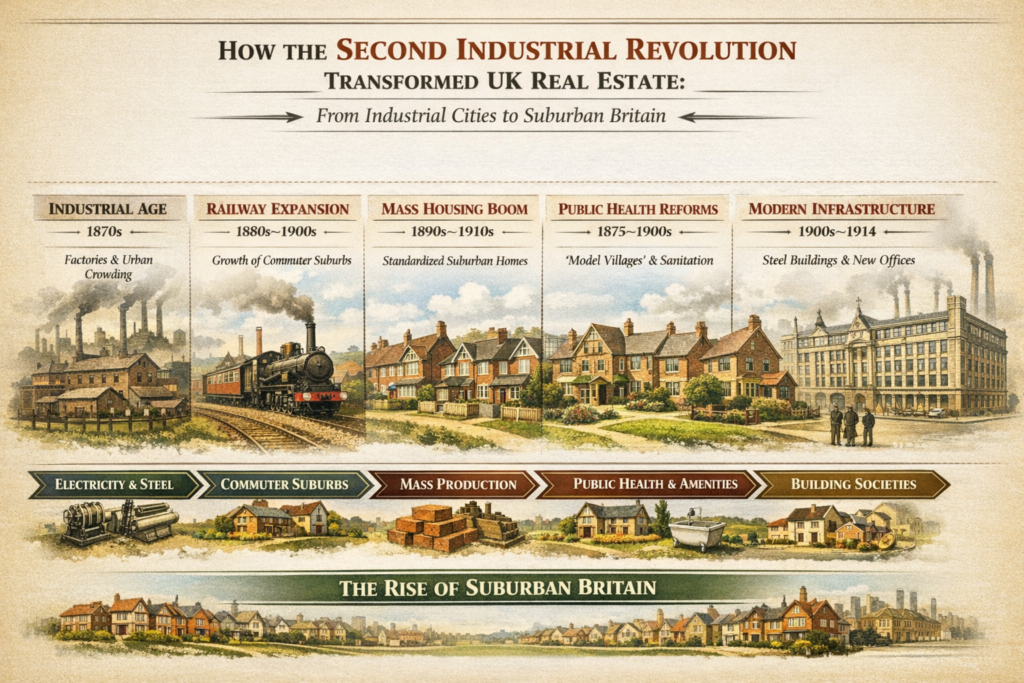
This visual timeline captures the sweeping transformation of UK real estate during the Second Industrial Revolution (1870–1914), a period defined by technological innovation, rising prosperity, and the birth of suburban Britain. Beginning with the crowded industrial cities of the 1870s, the image traces how railway expansion enabled the rise of commuter suburbs, allowing the middle and artisan classes to escape urban density. Mass housing followed, with standardized brick homes and garden plots becoming the norm.
Public health reforms—like the 1875 Public Health Act—ushered in sanitation standards and model villages, while new materials like steel and cast iron reshaped commercial and civic architecture. The emergence of building societies empowered working families to own homes, marking a shift from industrial housing to aspirational suburban living. Together, these forces redefined the urban fabric, giving rise to the modern British cityscape.
Housing became more modern
The housing story in the Second Industrial Revolution is also different from the first. The first wave was marked by rapid urban crowding, back-to-back housing, and highly uneven living conditions. The second wave did not erase those problems, but it came with greater state involvement, utility expansion, and later planning and housing reform.
Britain’s industrialisation created persistent demand for working-class housing, but over time public policy and municipal action increasingly shaped urban development. For real estate professionals, this is important because it marks the transition from informal urban expansion to a more regulated housing market.
Capital and empire mattered more in the second era
The Second Industrial Revolution was more capital-intensive than the first. Large-scale rail, steel, electrical, and manufacturing systems required more investment, more corporate organisation, and broader financial networks. That made access to capital even more important than in the earlier phase.
The British Empire should be framed carefully, but it is fair to say that imperial trade, resource access, and accumulated wealth supported Britain’s broader industrial and financial strength. In property terms, that meant more money flowing into urban infrastructure, commercial development, and institutional investment
How the two industrial revolutions differ
| Dimension | First Industrial Revolution | Second Industrial Revolution |
|---|---|---|
| Core driver | Steam power and mechanisation | Electricity, steel, telegraphy, petroleum, mass production |
| Property effect | Creation of factory towns and industrial housing | Expansion, standardisation, and system-driven urban growth |
| Infrastructure | Canals, early railways, improved roads | Dense rail networks, utilities, communications, electrification |
| Housing pattern | Dense worker housing, back-to-backs, poor sanitation | More regulation, wider utility access, growing public intervention |
| Financing | Early industrial capital and land reorganisation | Larger-scale corporate finance and capital-intensive development |
What this means for property investors today
The second revolution offers a useful investment lesson: the biggest property winners often sit where new systems converge. In the late 19th century that meant rail, power, communications, and urban services. Today, the same principle applies to transport, digital infrastructure, planning, and regeneration.
If the first industrial revolution created the industrial city, the second created the modern urban system. That is why it remains so important for anyone analysing long-run land value, industrial land, logistics property, and urban housing demand.
The long-term legacy in UK real estate
The lasting legacy of the Second Industrial Revolution is not just more factories. It is the emergence of a more integrated property market shaped by infrastructure, capital, utility networks, and public oversight. That shift made UK cities more complex, more scalable, and more dependent on planning.
For investors and real estate professionals, the message is clear. The first industrial era created the foundations of urban property; the second turned those foundations into a modern system. Understanding that difference helps explain why some places became durable growth markets while others were left behind.