
The Re-Engineering of Britain: How Industrialization Created the Modern Property Market
The First Industrial Revolution (c. 1760-1840) transformed UK real estate from a land-based rural system into an urban, infrastructure-driven property market. For property investors and real estate professionals, it is one of the clearest examples of how technology, transport, capital, and regulation can reprice land and reshape entire cities.
It didn’t just change how goods were made; it findamentally re-engineered the British landscape. It shifted the value of land from what sat on it (crops) to what sat under it (coal) and what could be built atop it (factories and high-density housing). This shift did not happen overnight. It unfolded through a sequence of major changes:
- enclosure and land consolidation,
- steam power and factory growth,
- canals and railways, rapid urbanisation, and eventually
- housing reform and building standards
Why this period matters in property economics history
Before industrialisation, land value in Britain was mostly tied to agriculture and estate ownership. As industrialisation accelerated, land near power sources, transport links, and labour pools became more valuable than purely rural acreage
That change is still relevant today. In modern property markets, the biggest value shifts often come from the same forces: infrastructure, employment access, density, and regulation. The First Industrial Revolution was the original large-scale example of that pattern.
The Transformation of UK Real Estate
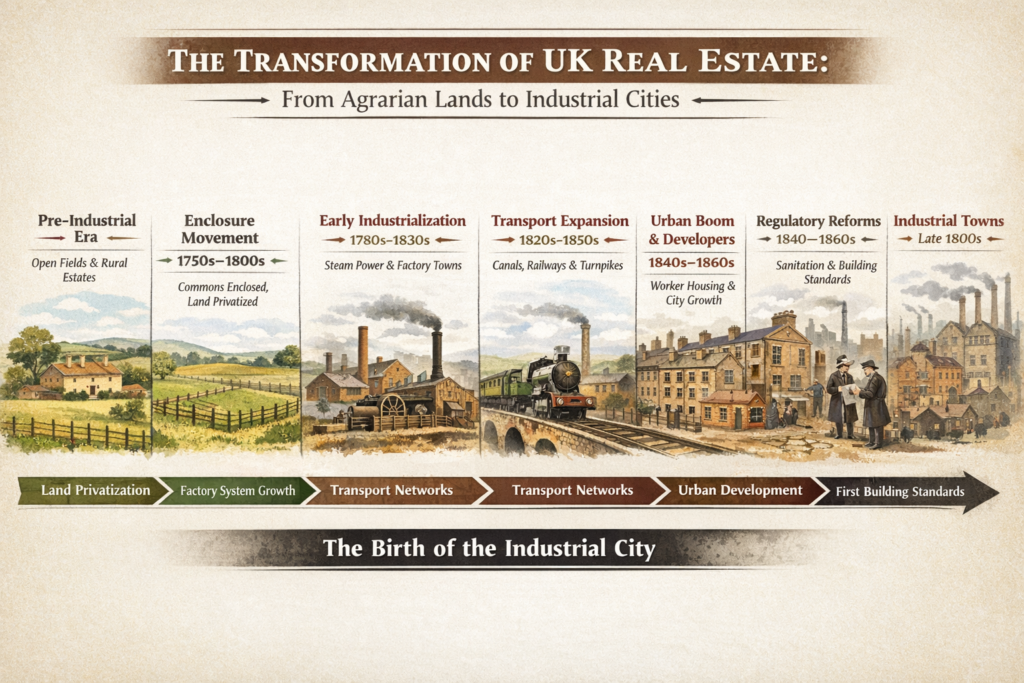
The image sequence tells a clear story: open fields and rural estates gave way to enclosed land, then to factory towns, transport corridors, and eventually dense industrial cities. This was not just an architectural change. It was a complete reordering of how land was used, valued, and developed.
From agrarian land to industrial cities
The enclosure movement consolidated land ownership and changed rural production, helping create a mobile labour force and larger-scale agricultural efficiency. At the same time, industrial demand pulled people away from rural districts and toward factory centres, where employment and housing were concentrated.
For real estate, this meant a shift from passive landholding to active urban development. Land no longer mattered only because of what could grow on it; it mattered because of where it sat in relation to industry, labour, and transport
The technology that changed land value
Before 1721, making clothes was a “cottage industry” where people worked from home using hand tools. John Lombe’s Derby Silk Mill changed everything by moving work into one massive, five-story building powered by a river.
By bringing hundreds of workers and machines together, Lombe proved that production could be centralized and scaled up. This shift turned land from just a place for farming or living into a high-value site for industrial factories, setting the stage for the modern world.
This transition from the Domestic System to the Factory System predated Watt’s steam engine, but it set the essential precedent: land was no longer just for farming or housing—it became a site for concentrated, high-output industrial capital.
Steam power was one of the defining innovations of the period. James Watt’s improved steam engine, developed with Matthew Boulton, made factory machinery far more efficient and reliable. That technical breakthrough helped industries move beyond water-powered sites and into locations that were better connected to labour and transport.
This mattered for real estate because it expanded the geography of industrial development. Factories no longer had to sit only beside fast-flowing rivers; they could be placed in towns and cities where land, labour, and markets were closer together.
For investors, this is a useful historical lesson: when a new technology changes the inputs of production, it often changes the value map of land as well. The steam engine did exactly that.
Transport drove the next wave of value creation
Transport improvements were just as important as industrial technology. The Bridgewater Canal, funded in the 18th century to move coal to Manchester, is one of the earliest examples of transport infrastructure directly supporting industrial growth. Canals reduced friction in the movement of heavy goods and made industrial production more scalable.
Road improvement also played a role. John Loudon McAdam’s road-building methods improved durability and all-weather use, making inland transport more efficient. Better roads supported trade, travel, and the movement of workers and materials.
Railways then accelerated everything. The Liverpool and Manchester Railway cut journey times dramatically and became a landmark in transport history. Once rail connectivity arrived, industrial land near stations and freight routes gained a major advantage over less-connected areas.
This is one of the clearest property insights from the period: transport infrastructure does not just move goods. It creates new value zones.
The rise of industrial real estate
Industrial real estate during the First Industrial Revolution evolved from small domestic workshops into large, purpose-built factory complexes. Mills, foundries, warehouses, and production sites were increasingly designed around machinery, power, and output rather than around traditional craft production.
This was also the era of architectural and engineering change. Larger industrial buildings required better structural design, fire resistance, and more efficient layouts. The growth of industrial production encouraged standardisation and repeatable building forms, which made development faster and more scalable.
A key example is the move from water-driven sites to steam-driven complexes. Once factories were no longer tied to river power, they could cluster in urban or semi-urban areas with better labour access and market reach. That shift helped create the industrial city as a new real estate form.
The rise of working-class housing
The industrial boom produced a huge demand for housing near factories. Workers needed to live close to employment, and developers responded with dense rows of terraced housing, back-to-back houses, lodging houses, and factory-owned “tied” housing.
The result was fast urban growth, but also poor living conditions. Many working-class families lived in overcrowded, under-served accommodation with weak drainage, limited sanitation, and little separation between homes and industry. In some districts, housing density became extreme, reflecting the pressure of rapid industrial urbanisation.
For property professionals, this is an early example of a recurring market pattern: when employment expands faster than housing supply and infrastructure, density rises, quality falls, and reform follows later.
Class-based housing became more visible
One of the most important outcomes of industrialisation was the sharp class divide in housing. Lower-income households typically lived in cramped terraces or subdivided lodging houses near workplaces, while a growing industrial middle class moved into larger suburban villas and better-planned streets.
This was not just a housing trend; it was a spatial expression of economic hierarchy. The industrial economy created new wealth, but it also concentrated hardship in specific districts and pushed higher-income groups toward better locations and more desirable urban edges.
That pattern is still familiar in modern cities. Access to clean streets, drainage, transport, and open space continues to shape property demand and social geography.
It is fair to say that imperial trade markets, fuel, raw materials, and accumulated capital helped finance factories, transport networks, and urban growth, all of which altered land values and development patterns.
Reform followed disruption
By the mid-to-late 19th century, the consequences of industrial urban growth became impossible to ignore. Sanitation problems, unsafe structures, and overcrowded housing pushed authorities toward regulation and public health reform.
Building regulation became more formalized over time, and local authorities gained more power to address dangerous housing conditions and clear slums. These reforms did not reverse industrialisation, but they did reshape how cities could be built and managed.
From a real estate perspective, this was a major turning point. The market was no longer purely about private land use; it was now shaped by public standards, health policy, and planning controls.
What property investors can learn
The First Industrial Revolution offers several lessons that still apply to real estate today.
-
Infrastructure creates value. Canals, roads, and railways changed land demand by changing access.
-
Technology changes location economics. Steam power freed factories from river sites and expanded industrial land options.
-
Housing follows jobs. Industrial growth created urgent demand for nearby worker housing.
-
Regulation follows risk. Poor sanitation and overcrowding eventually forced reform.
-
Location premiums are dynamic. Land value shifts when the economic logic of a place changes.
For investors and developers, the underlying message is simple: property markets are never static. They respond to the same forces that transformed Britain’s industrial cities — power, transport, labour, capital, and regulation.
A lasting legacy in UK real estate
The First Industrial Revolution did more than build factories. It created the template for modern urban property markets: concentrated employment, transport-led land value, dense housing, and eventually regulated development.
The images capture that transition well. They show the movement from agrarian land to enclosed estates, from steam-powered factories to rail corridors, from worker housing to urban expansion, and finally to the first building standards. That sequence is essentially the birth of industrial real estate in Britain.
For anyone analysing UK property today, this history is more than academic. It explains why certain places became cities, why some corridors grew faster than others, and why infrastructure has always been one of the most powerful drivers of value.